


Super tax case: taxpayers’ lawyer argues as SC hears FBR appeals
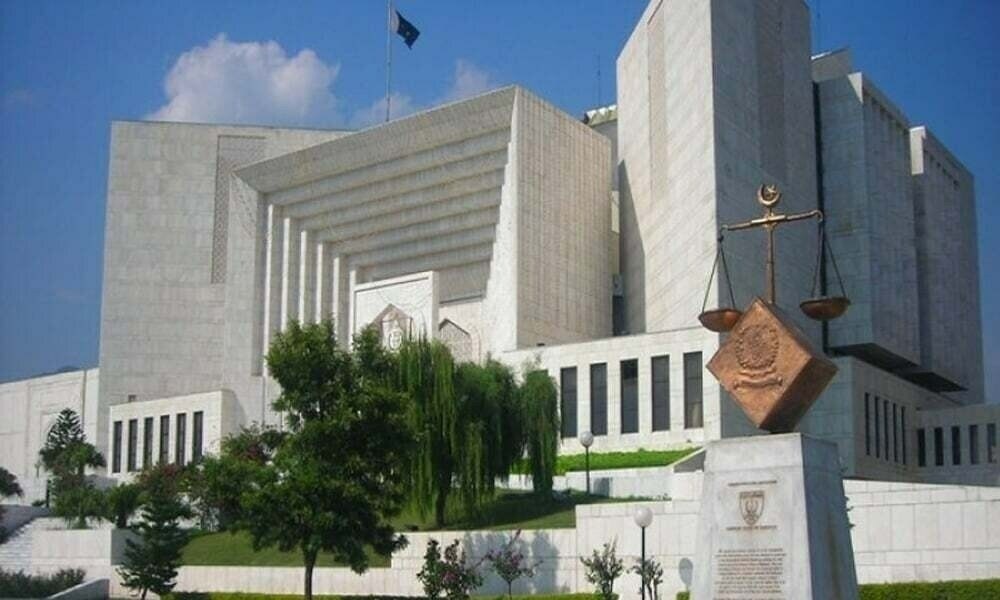

ISLAMABAD: The Supreme Court was told that Super Tax under Section 4C cannot be imposed by disallowing carried forward losses, admissible expenses, and depreciation allowance, as this would mean a simultaneous imposition under entries 47 and 52, which is not permissible under the Constitution.
A five-judge Constitutional Bench of the Supreme Court, headed by Justice Amin-ud-Din Khan, on Wednesday heard appeals of the Federal Board of Revenue against the judgments of the Sindh, Lahore, and Islamabad High Courts regarding the levy of Super Tax under Section 4C of the Income Tax Ordinance, 2001.
Barrister Ovais Ali Shah, representing the taxpayers, argued that the liability of the taxpayers can only be determined by reference to the law as it stood on the date of crystallization; i.e., 30.06.2022, for normal tax years, and the respective closing dates for special tax years.
He submitted that the Islamabad High Court’s impugned judgment has correctly applied the principle laid down by this Court that the liability to pay income tax accrues on the last day of the accounting year. Once the tax year has closed, the taxable event is complete, and the income of the taxpayer for that year stands concluded. Consequently, liabilities had crystallized on 30.06.2022, and subsequent fiscal legislation cannot retrospectively alter such vested rights, the counsel added.
Ovais stated that the test for disturbing a crystallised liability is high and the language used must be very specific, adding that in the instant case, none of the provisions contained in Sections 4, 9, 11, and 74 have been disturbed. Section 4C also does not contain any non-obstante clause, nor has a deeming clause been provided.
He argued that the wording of Section 4B must be read in favour of taxpayers, as it expressly provided that no super tax was applicable for Tax Year 2022, and this provision was never amended.
As such, this creates a vested right in favour of the respondent taxpayers which cannot be taken away by subsequent legislation.
The subsequent enactment of Section 4C, which purported to impose the super tax for the same period; therefore, stands in direct and irreconcilable conflict with Section 4B.
Ovais maintained that the super tax cannot disallow carry-forward losses or depreciation, as this would create simultaneous taxation under Entries 47 and 52. When Section 4C denies statutory carry-forward rights or reintroduces final tax incomes into charge, it effectively operates as a presumptive tax. Such a levy cannot constitutionally coexist with the normal income tax regime under Entry 47.
He requested that to preserve constitutionality, Section 4C must be read down and confined strictly to incomes computed under the normal regime. Any broader construction would violate the constitutional division between Entry 47 and Entry 52. In such circumstances, any ambiguity or inconsistency must, in law, be resolved in favour of the taxpayer.
Ovais argued that the proviso added to Section 4C is inherently discriminatory as it treats people falling under the same class and category differently. The purpose of the statute is relevant when determining intelligible differentia, and here the purpose is clearly the imposition of an income tax.
However, people earning the same income are treated differently under the proviso, creating unequal burdens within a uniform class of taxpayers. On the face of it, there is no intelligible differentia that justifies this disparate treatment.
He asked the bench that the judgments rendered by the Islamabad High Court in the Fauji Fertilizer Co. Ltd. v. Federation of Pakistan and by the Sindh High Court in Shell Pakistan Ltd. v. Federation of Pakistan are sound in law and ought to be upheld.
After Ovais, Farogh Naseem commenced his arguments, as he was presenting his case.
The bench adjourned the hearing until today (Thursday).
Copyright Business Recorder, 2025


























Comments
Comments are closed for this article.