


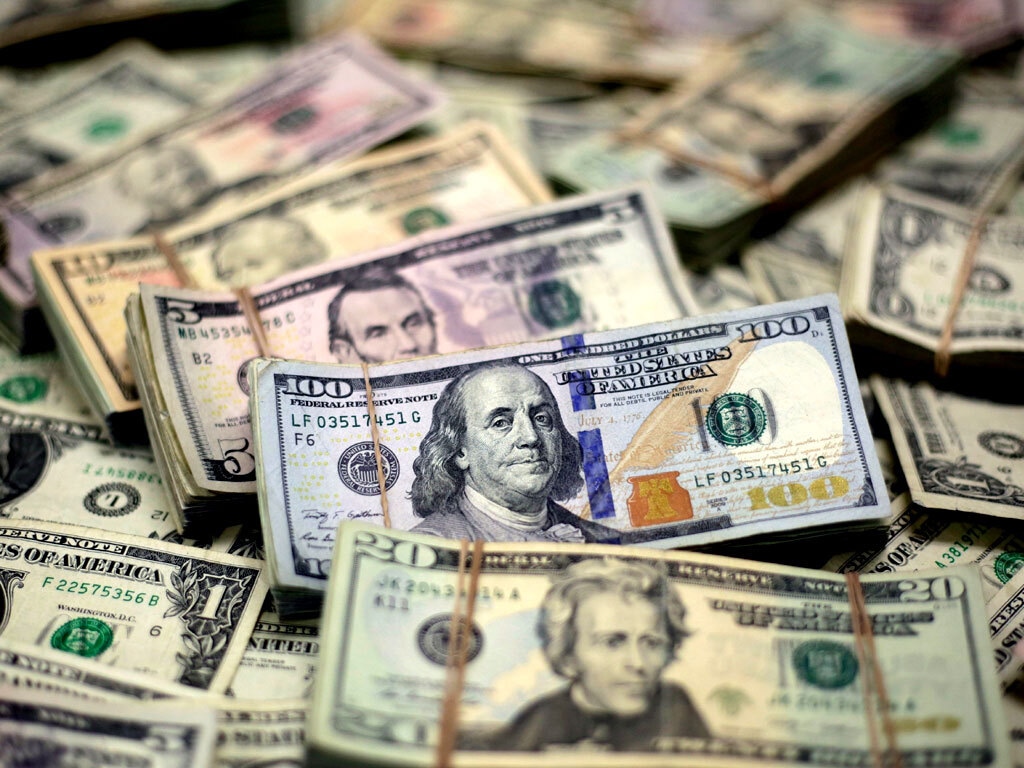

NEW YORK: The US dollar fell on Monday, extending losses after Friday’s weak US jobs report that reinforced expectations of a Federal Reserve rate cut this month, while the yen fell broadly after Japanese Prime Minister Shigeru Ishiba announced his resignation over the weekend.
The focus for markets will also be on French Prime Minister Francois Bayrou’s confidence vote later in the day, which he is expected to lose. The announcement of the vote, which Bayrou himself called, has plunged the euro zone’s second-largest economy deeper into political crisis.
In Japan, Ishiba on Sunday said he would step down, ushering in a potentially lengthy period of policy uncertainty for the world’s fourth-largest economy, the most heavily indebted industrialised nation.
That pushed the yen lower across the board and by mid-morning trading, the dollar was just up 0.2 percent against the Japanese currency at 147.695 after rising by as much as 0.8 percent on the day. The Japanese currency similarly slid to its lowest in more than a year against the euro, which rose 0.3 percent on the day to 173.25 yen.
But the market’s attention remained firmly pinned on the US dollar after a non-farm payrolls shock on Friday that all but cemented the Fed cutting interest rates at a policy meeting later this month.
“The driving force in the foreign exchange market remains the dollar and US developments,” said Marc Chandler, chief market strategist, at Bannockburn Forex in New York.
“People can talk about Japanese politics, but the real driver of dollar/yen is not Japanese politics, or Japanese interest rates. It’s US interest rates, and with the market pricing in about a 10 percent chance of 50 basis point cut, the dollar is falling.”
Fed funds futures are pricing in a 90 percent chance of a standard 25 basis-point cut this month and a 10 percent chance of 50-bp rate decline, according to LSEG estimates.
The nonfarm payrolls report showed US job growth plunged in August and the unemployment rate increased to nearly a four-year high of 4.3 percent.
Investors are focusing on the chance of Ishiba being replaced by an advocate of looser fiscal and monetary policy, such as Liberal Democratic Party veteran Sanae Takaichi, who has criticised the Bank of Japan’s interest rate hikes.
“The probability of an additional rate hike in September was never seen as high to begin with, and September is likely to be a wait-and-see,” Hirofumi Suzuki, chief currency strategist at SMBC, said of the BOJ’s next move.
“From October onwards, however, outcomes will in part depend on the next prime minister, so the situation should remain live.”
Japanese stocks surged while government bonds (JGBs) were steady, though yields on super-long JGBs hovered near record highs.
The yen hardly reacted to data on Monday showing Japan’s economy expanded much faster than initially estimated in the second quarter.
In other currency pairs, sterling edged up 0.2 percent against the dollar to USD1.3534, having risen more than 0.5 percent on Friday, while the euro rose 0.2 percent to USD1.1741, after hitting a more than one-month high on Friday.
The dollar index edged down 0.3 percent to 97.6, having tumbled more than 0.5 percent on Friday.




















Comments
Comments are closed for this article.