


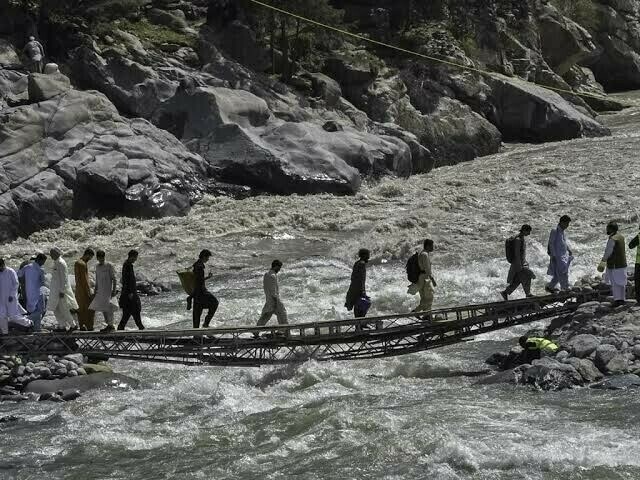

ISLAMABAD: The devastating floods triggered by monsoon rains have resulted in the destruction of 73 bridges, sweeping away 651 kilometres (kms) of road infrastructure besides killing 295 people and injuring 700 countrywide within past one month.
According to official flood-related data released here on Thursday by the National Disaster Management Authority (NDMA), the monsoon rains also have resulted in the destruction of 1,600 houses, of which, 542 fully and 1,058 partially.
Moreover, the floodwaters also killed 376 livestock, of which, 139 in Khyber Pakhtunkhwa (KPK), 121 in Punjab, 85 in Sindh, 17 in Gilgit-Baltistan (G-B), and 14 in Azad Jammu and Kashmir (AJK).
NDMA warns of floods, landslides in Punjab, KP, GB and AJK amid heavy rains
Of 295 flood-related deaths, 162 are reported in Punjab, 66 in KPK, 28 in Sindh, 20 in Balochistan, nine in G-B, eight in Islamabad Capital Territory (ICT) and two in AJK, while out of 700 injuries, Punjab reported 558, KPK 81, Sindh 40, 10 in AJK, four each in AJK and G-B and three in ICT.
Children remained most vulnerable to the monsoon rains as out of 295 flood-related deaths, 138 were children and 236 children were injured, while the heavy rains also have killed 202 men, 55 women, injured 265 men and 199 women.
The floodwaters have destroyed 634.33kms of road network in KPK, 13.74kms in G-B and 1.5kms in AJK and Balochistan apiece, while sweeping away 41 bridges in KPK, 28 in G-B, three in ICT and one in Balochistan. Out of 1,600 houses damaged, 534 in G-B, of which, 343 fully and 191 partially, 320 in AJK of which 60 fully and 260 partially, 309 in KPK of which 93 fully and 216 partially, 87 in Sindh of which 33 fully and 54 partially, 80 in Balochistan of which 11 fully and 69 partially, and 56 in ICT of which one fully and 55 partially.
Meanwhile, the NDMA’s National Emergencies Operation Centre (NEOC) has issued multiple impact-based weather alerts in view of an intensifying monsoon system across different regions of the country.
As per the advisory, monsoon currents are likely to be intense from 31st July to August 3. A westerly wave may further strengthen this weather activity, increasing the risk of urban flooding, flash floods, and glacial hazards in vulnerable areas.
Urban flooding is expected in Islamabad and several metropolitan cities of Punjab, particularly in low-lying areas of Rawalpindi, Gujranwala, Lahore, Sialkot, Khushab, and Narowal. Localised inundations may also occur due to the sudden swelling of nullahs in north-eastern Punjab, especially Bein, Basanter, and Deg Nullah. People residing in these flood-prone areas are advised to remain vigilant and avoid unnecessary travel during intense weather. Rapid water level rises in streams, nullahs, and rivers can pose serious life-threatening risks, especially to those living near their banks or on hilly slopes.
Meanwhile, widespread rainfall is also expected in various districts of KPK, including Chitral, Dir, Swat, Kalam, Mansehra, Battagram, Abbottabad, Haripur, Swabi, Mardan, Peshawar, Charsadda, Kohat, Hangu, Bannu, Lakki Marwat, Dera Ismail Khan, and surrounding areas. These areas may experience localised urban and low-lying area flooding.
There is also an increased risk of landslides and flash floods in hilly areas, along with the possibility of strong winds and thunderstorms which could knock down weak trees and power lines, causing short-term power outages. Rain and dust may also reduce visibility, increasing the likelihood of road accidents.
At the same time, a Glacial Lake Outburst Flood (GLOF) alert remains in place for the glaciated regions of G-B and KPK, where a combination of heavy rainfall and recent heat-induced glacier melt is likely to trigger GLOFs and flash floods until August 3.
Vulnerable valleys include Badswat, Hinarchi, Tersat, Hundur, Darkut, Ishkomen, Shisper, Reshun, Brep, Booni, Sardar Gol, and Arkari. These areas are at heightened risk of sudden downstream flooding, landslides, damage to roads and power infrastructure, and disruption of access to remote areas.
The NDMA advises all relevant provincial and district administrations to ensure the operational readiness of flood response teams, clear drainage systems, and make necessary arrangements for possible evacuation and rescue operations. Tourists and travellers are strongly advised to avoid high-altitude and glacial regions of GB and KP during the forecast period.
The NDMA is closely monitoring the evolving situation through NEOC and remains in constant coordination with provincial and district disaster management authorities to ensure a timely and coordinated response. Citizens are encouraged to stay updated through official channels and download the “Pak NDMA Disaster Alert” mobile application for real-time alerts and guidelines.
Copyright Business Recorder, 2025
























Comments
Comments are closed for this article.