




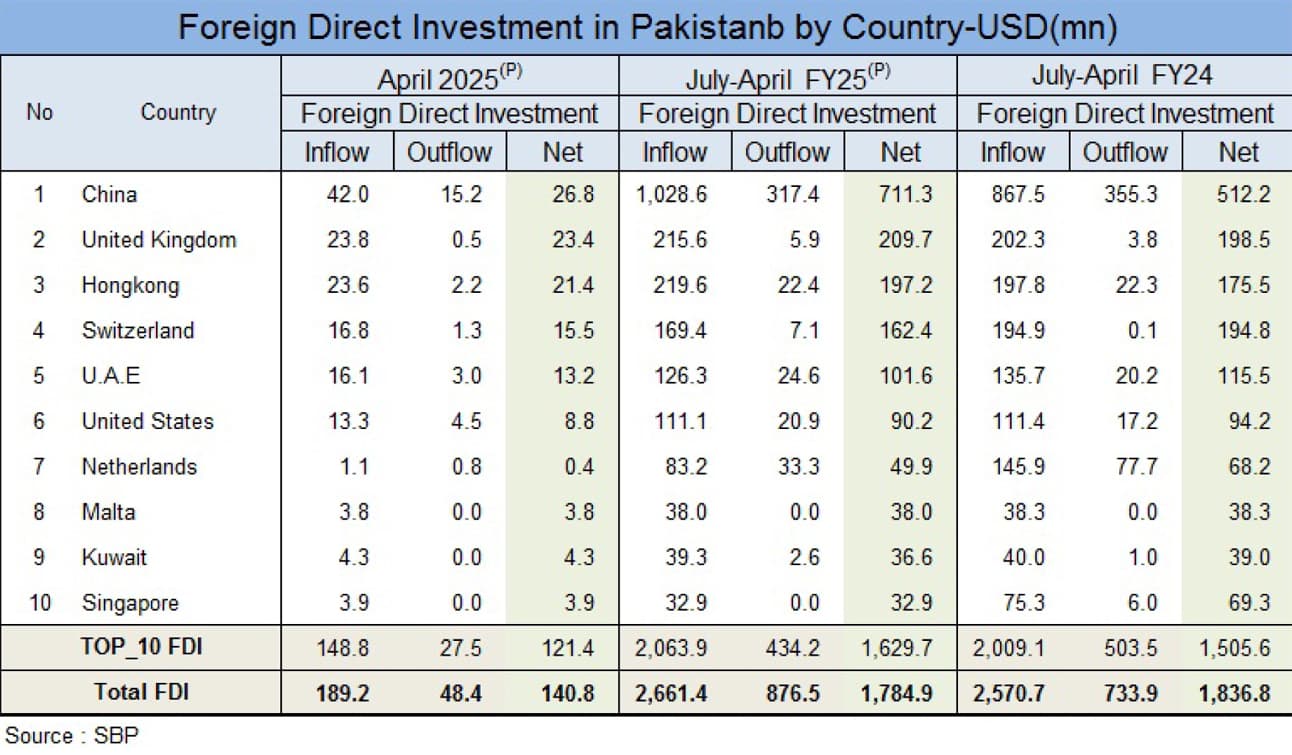
Pakistan attracted net foreign direct investment (FDI) worth $1.784 billion during the first ten months of FY25, marking a modest 3 percent year-on-year decline compared to the same period last year.
The data, released by the State Bank of Pakistan (SBP), shows that despite high-level diplomatic efforts and structural policy interventions, particularly through the Special Investment Facilitation Council (SIFC), FDI continues to hover at historically low levels.
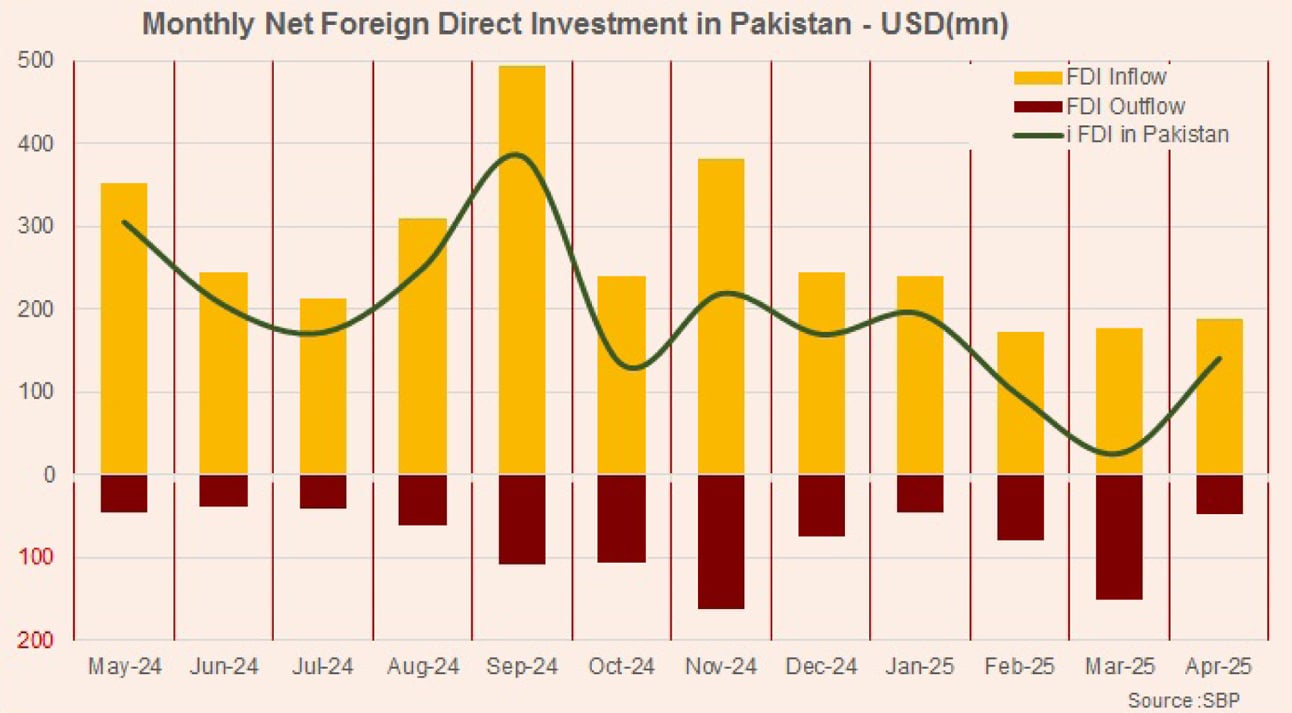
The April 2025 numbers reinforced this concern—net inflows plunged by 91 percent year-on-year, falling to just $25.75 million, one of the lowest monthly figures recorded in recent years.
In terms of source countries, China led the pack in April 2025 with a modest inflow of $27 million, reaffirming its role as Pakistan’s largest investor.
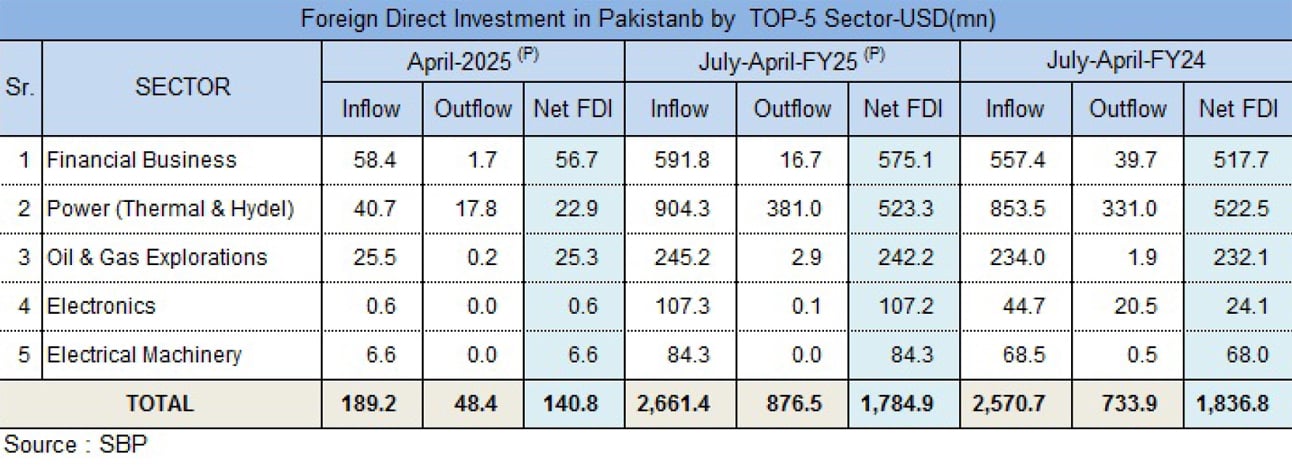
However, even this investment appears minimal given the claims made on the scale of bilateral economic cooperation under CPEC. The rest of the FDI landscape remains thin, with little to no significant traction from other major economies.
The role of the SIFC has been central to Pakistan’s has been in the limelight. According to recent government disclosures, the country has secured over $2.3 billion in investment since the launch of the SIFC, particularly targeting sectors like mining, agriculture, IT, and energy.
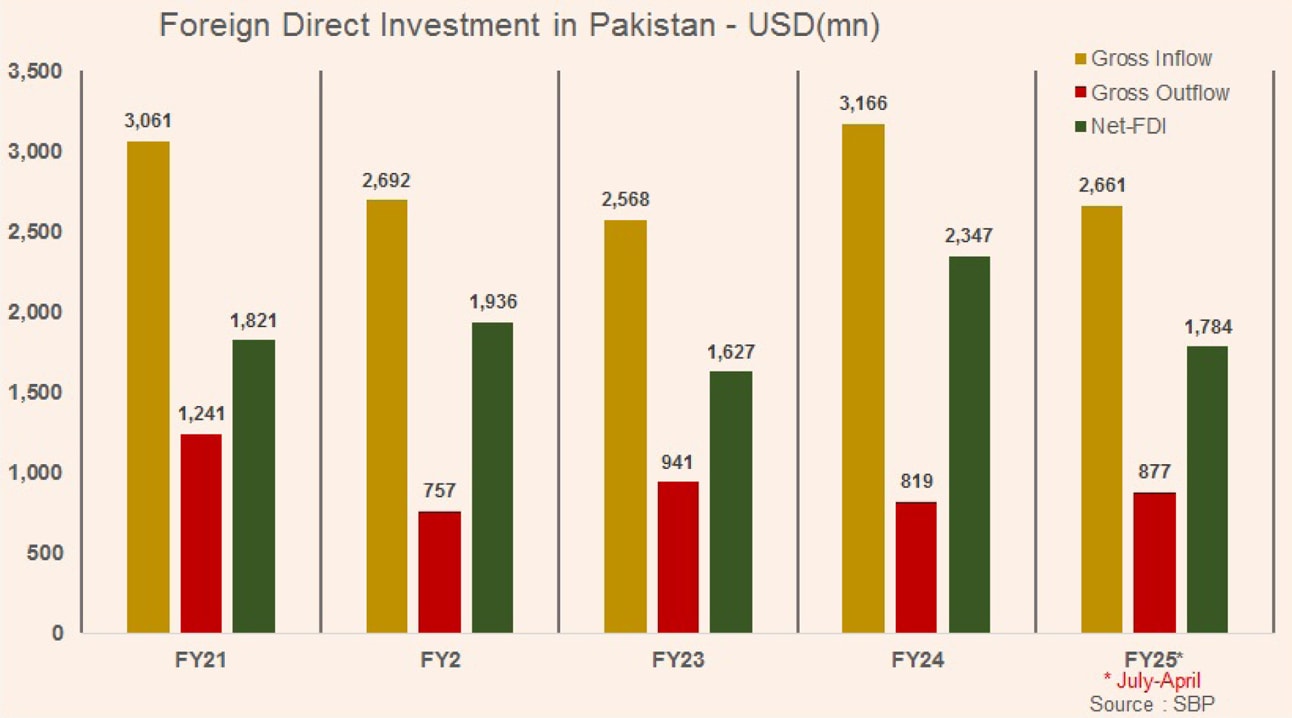
While FDI of $2.3 in FY24 was a growth of over 50 percent year-on-year, the tally continues to be much lower than what the country attracted back in 2000s. Also, many a times such news reports also include early commitments and MoUs.
The outlook for FDI in Pakistan remains challenging. Still, the investor confidence remains subdued amid broader structural issues: macroeconomic instability, weak contract enforcement, inconsistent taxation, and regulatory overreach.
Global capital is increasingly cautious, and Pakistan’s current risk-reward equation offers little differentiation in a competitive region.
Neighbours like India, Vietnam, and Bangladesh continue to outperform Pakistan, driven by stronger industrial ecosystems, more predictable policies, and better ease-of-doing-business.
The country needs deeper reforms focused on regulatory certainty, judicial efficiency, investor protection, and sector-specific facilitation. Without this foundation, flagship initiatives may only yield short bursts of interest but fail to catalyse the long-term capital Pakistan urgently needs.




















Comments
Comments are closed for this article.