


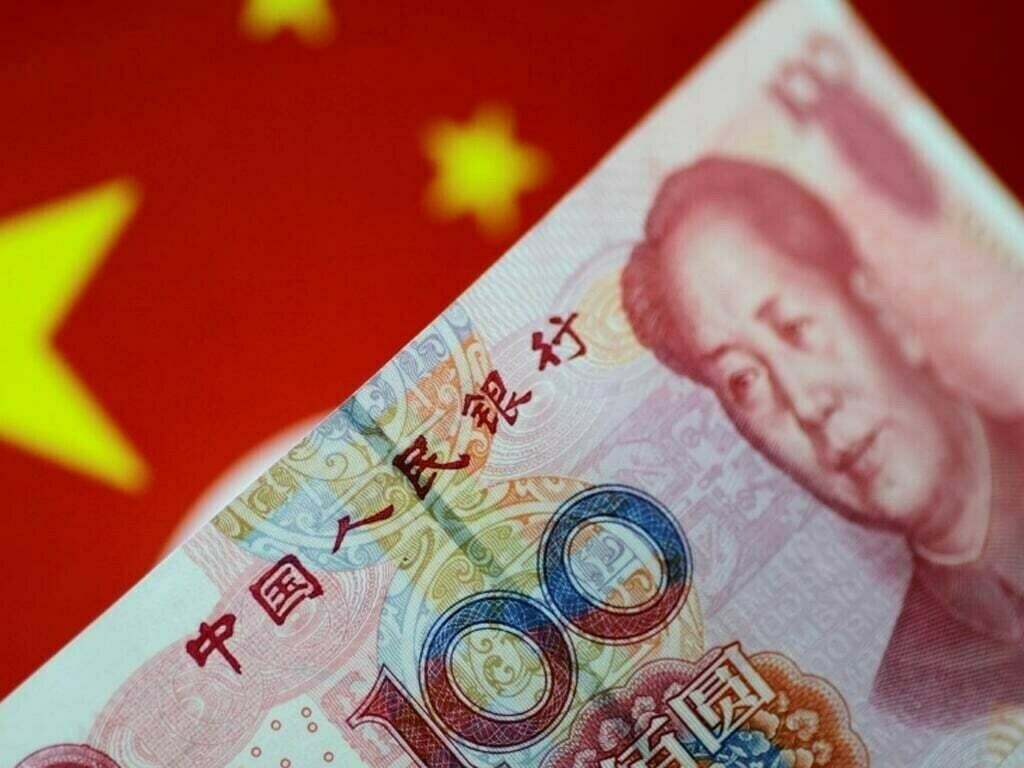

SHANGHAI: China’s yuan slipped against the dollar on Monday, pressured by some weaker-than-expected data on economic activity, while corporates scrambled to buy cheaper dollars after a surprise downgrade of the US government’s credit rating.
Retail sales, a gauge of consumption, rose 5.1% in the world’s second largest economy in April, off the March increase of 5.9%, and missing forecasts of 5.5%, data showed on Monday, as a trade war threatened to dampen momentum.
New home prices also stayed lukewarm last month, signalling persistent downward pressure despite measures to stabilise the industry.
“The recent trade truce between the United States and China has given the yuan some breathing space, but growth pressures remain,” Barclays analysts said in a note, after the world’s two largest economies agreed to roll back the majority of their April tariffs on each other’s goods.
By 0342 GMT, the onshore yuan was 0.08% lower at 7.2159 per dollar, while its offshore counterpart was down about 0.04% in Asian trade at 7.2163.
That compared to a six-month peak of 7.1855 hit last week following the trade truce.
Currency traders said recent dollar weakness after Moody’s cut of America’s top sovereign credit rating prompted overseas listed Chinese companies to fulfil their foreign exchange demand for dividend payments.
These Hong Kong-listed Chinese companies usually need to pay dividends to overseas shareholders between May and August.
Prior to the market open, the People’s Bank of China (PBOC) set the midpoint rate, around which the yuan is allowed to trade in a 2% band, at 7.1916 per dollar, its strongest since April 3 and 141 pips firmer than a Reuters’ estimate of 7.2057.
Yuan firms on better sentiment
“The gap between USD/CNY fixings and the market estimate has narrowed while the CNH-CNY basis remains small, suggesting limited stress or directional impulse on the Chinese currency at present,” the Barclays analysts said.
“It appears that the PBOC is quite content to let the yuan pivot around the 7.20-level for the time being.”
Maintaining yuan stability remains a key objective for policymakers, said Christopher Wong, a foreign exchange strategist at OCBC Bank.
“Any sharp yuan appreciation may risk triggering exporters rushing to sell their dollar holdings and that cycle may result in excessive yuan strength and volatility, which is not desirable for policymakers.”


























Comments
Comments are closed for this article.