



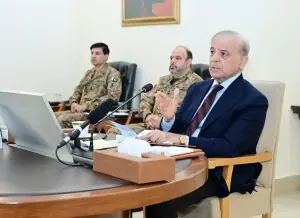
EDITORIAL: Following up on his declaration of an “education emergency” at a recent international conference, Prime Minister Shehbaz Sharif has called for coordination between the federal and provincial governments to enroll some 22.8 million out-of-school children, majority of them girls.
Although post the 18th Amendment, education is a provincial subject, he said the Centre should “aggressively work” with provincial governments to deal with the challenge — hopefully undistracted.
Some of the previous governments too had shown enthusiasm for reform only to let it fizzle out with the result that Pakistan lags behind all South Asian countries on this score as well as other human development indices.
There have been some appreciable efforts at reform, though. As the PM recalled at the aforementioned conference, during his term as chief minister of Punjab, in a “major step” to address disparities in the sector he had established Danish Schools, providing quality education to underprivileged children in rural and underdeveloped areas that, he said, paved way for a promising and more inclusive future.
And a successor government in that province tried to enhance enrolment by giving poor families monetary incentives to send their children to school.
Another worthwhile initiative is a newly instituted Pakistan Education Endowment Fund to help students from low-income families pursue higher education. But such partial projects do little to break systemic stagnation.
A meaningful reform effort calls for a holistic approach backed by substantial financial input.
Notably, compared to urban areas more children living in rural regions are deprived of access to classrooms.
To make a bad situation worse in many rural areas, particularly of Sindh, there is the phenomenon of ghost schools and ghost teachers who regularly draw salaries without ever setting a foot in schools since they exist either only on paper or have been occupied by local politically influential individuals.
Whereas UNESCO recommended level of educational funding is 4 to 6 percent of the GDP our government spends only 2.5 percent of the GDP.
The resource constraint shouldn’t act as an impediment if our policymakers get their priorities right.
Needless to say, low government spending together with lack of proper monitoring of what the public sector education authorities do or not do prevents children from disadvantaged backgrounds to fully realise their potential, limiting their ability to contribute to national productivity.
For far too long education, the building bloc of socio-economic progress and prosperity, has been left by the way side. In a world of knowledge-based economies it is very concerning that we have some 22.8 million children out of school.
At the rate our population is growing, that number is going to go up and up unless education emergency is effectively implemented. All provincial governments must get their act together to make universal school enrolments a reality.
Copyright Business Recorder, 2025























Comments
Comments are closed for this article.