


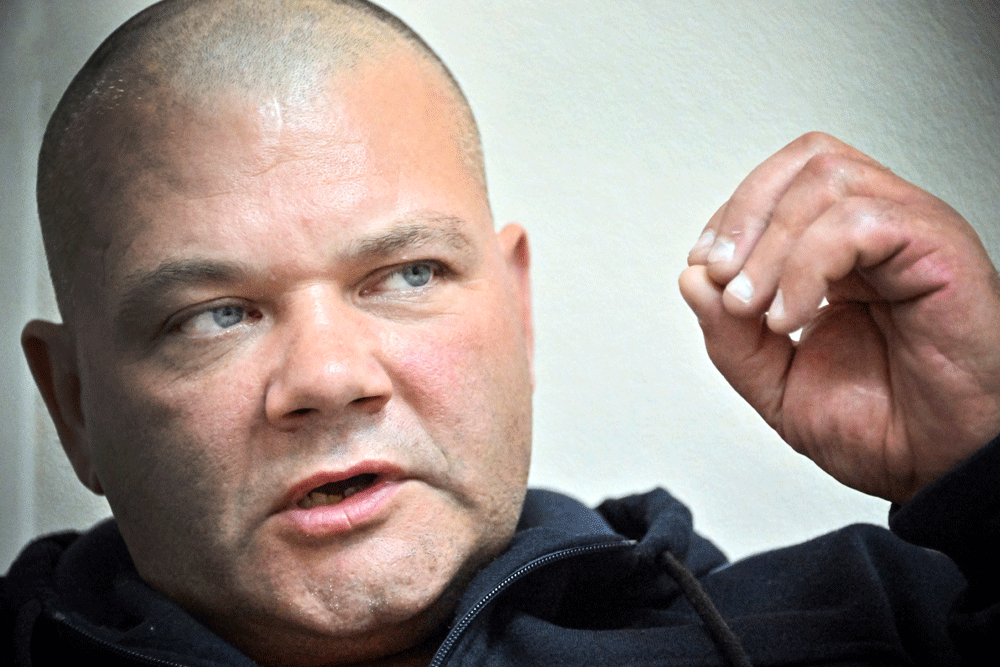

ZHUKOVSKY: Alexander Fyodorov has spent most of his life in Russian prisons. During his latest sentence, an unexpected opportunity came up – the chance to fight for the Wagner Group in Ukraine.
For six long months, Fyodorov fought on the Russian side in the hellish battle to conquer the town of Bakhmut.
The 46-year-old survived and, as promised by his commanders, received a medal and was released from prison.
The ex-convict is now being helped by a group called the “Union of Veterans of the Special Military Operation” (in Ukraine) which campaigns for greater social and psychological support for combatants returning from the front.
The organisation, which is independent from the defence ministry but is in line with Kremlin thinking, says rehabilitating traumatised ex-fighters is a challenge for Russia and efforts made so far still leave a lot to be desired.
‘A normal person’
The union helped arrange Fyodorov’s first ever psychological consultation last month, which AFP was able to attend.
“What would you like to do now?” therapist Anna Kosyreva asked at the session in the town of Zhukovsky near Moscow.
“I would like to be a normal person,” said Fyodorov, sitting in a room that would normally be used for therapy sessions with children.
Fyodorov, who has a shaved head and a tattoo of a spider web on one of his hands, wore a black jacket bearing the Wagner logo – a skull inside a target sight.
He said he grew up in an orphanage before embarking on a life of crime, and that he “loves the Russian people very much”.
He has served a total of 25 years in prison for various crimes.
He is a big fan of late Wagner leader Yevgeny Prigozhin, himself a former convict who in 2022 visited several prisons to enrol detainees to fight and who died in a plane crash last month.
Lack of support staff
During the bloody conquest of Bakhmut, Fyodorov said his unit was tasked with infiltrating behind enemy positions and then calling in assault groups to attack.
In the dormitory of a modest Moscow hotel where he is being housed temporarily, Fyodorov showed off photos of the two medals he has received for his service.
One is from the Wagner Group, the other is from President Vladimir Putin.
He said that he “lives in the present without looking to the future”, and thinks the social rehabilitation of former soldiers and fighters is “vital” so they do not “lose themselves and turn to drink”.
“A problematic individual will be a problem on our streets,” said Oleg Panchurin, head of the “Union of Veterans of the Special Military Operation”.
“That is why we have to look after each person,” he said.
A deputy commander in the 71st motor rifle regiment, the 32-year-old has taken part in the conflict in Ukraine.
In July, he was injured in Robotyne, one of the flashpoints in the ongoing counteroffensive by Ukrainian forces in the south of the country.
He moves around on crutches.
“If we do not take (former fighters) into account, they start to be offended by the system. We have to show that we value them,” he said.
He said the government has been providing financial and other material assistance to veterans but that there was a lack of psychiatrists, lawyers and social workers who can help.
With two other non-governmental organisations – “Dobrye Lyudi” (Good People) and “Officers of Russia” – the veterans’ union has launched its own programme to provide therapy and get veterans back into civilian life.
‘Own little world’
Another member of the veterans’ union in Moscow is Elnur Khismatullin, 30, a former special forces soldier and police officer who joined Wagner in 2022.
Khismatullin, who originates from the Bashkiria region, also fought in Bakhmut and said he suffered six concussions after coming under Ukrainian shell fire.
Evacuated from the conflict zone, he said he lost his speech and suffered from post-traumatic stress syndrome.
When he came back to Russia, he started speaking normally only after two months of psychological consultations.
Since then, helping other veterans has become “the meaning of my life”, he said.
He said he regrets the lack of consideration of many fellow Russians, who prefer to ignore the conflict and live “in their own little world”.
Khismatullin is trying to raise funds for the treatment of a Russian soldier found half-dead on the battlefield in 2022 after suffering a severe brain injury.
The injured soldier is now in a hospice near Moscow, bedridden, mute and alone.
The veterans AFP spoke to said they wanted to avoid the kind of suffering seen after the Soviet war in Afghanistan and the Chechen wars, in which thousands of former soldiers found themselves adrift without assistance.
Alexander Bosenov, who also fought for Wagner in Bakhmut, said the intensity of the fighting in Ukraine was comparable to World War II.
“We have to compare this to 1941 (the year Nazi Germany attacked the Soviet Union) when our grandparents were all in trenches, without water or food,” the 25-year-old said.
Now back from the front, he said he could end up working in security or training new recruits.
“I can fire all types of weapons, including mortars,” he said with a leer.
Then he showed off a long white scar on his head – the trace of a sniper’s bullet which grazed his scalp.






















Comments
Comments are closed for this article.