



EDITORIAL: Exports have risen to 20.5 billion dollars in the first eight months (July-February) of the current fiscal year compared to 16.3 billion dollars in the comparable period of the year before — a rise of around 26 percent. While this highly significant increase must be appreciated yet two observations are in order. First, the rise in exports is not as much in volume as in a rise in the general price level in importing countries as well as the resurgence of sales subsequent to the easing of pandemic-related restrictions.
And second, Pakistan’s major textile products’ buyers are in the West including the European Union — which extended the GSP plus status to Pakistan in 2014 that continues to contribute significantly to a rise in our textile exports to Europe.
Western countries are pressurizing those that have not denounced the Russian invasion of Ukraine to do so, including China, its Foreign Minister, Wang Yi, told his Spanish counterpart this week that China “is not party to the crisis, still less wants to be affected by the sanctions” imposed on Russia. Pakistan, from an economic perspective, is in a much weaker position economically and cannot afford to be impacted by Russian sanctions and in this context one would hope that cabinet members, including the Prime Minister, do not make any public comments and instead allow the Foreign Office to deal with it.
Notwithstanding the significant rise in exports from the year before it is the trade balance (the difference between exports and imports) which is the key macroeconomic indicator as opposed to looking at just one of its components.
The data released by the Pakistan Bureau of Statistics (PBS) shows that imports rose from 33.8 billion dollars in the first eight months of 2020-21 to 52.5 billion dollars in the comparable period of the current fiscal year or a rise of 55.07 percent. In other words, while exports have risen by 26 percent July-February this year in comparison to the same period the year before imports have risen by double that amount –,i.e., by 55.07 percent. While one can understand that a political government naturally focuses on the positive indicators yet in this instance there is no ministry that is willing to take responsibility for the rise in imports.
The Ministry of Commerce argues that the bulk of the imports, petroleum and products and food imports, are not dependent on its policies while the Ministry of Industries acknowledges that part of the rise in imports – raw materials and semi- finished products – but argues that these imports fuel domestic output and hence must be supported.
To further complicate matters imports are a major source of government revenue and hence any attempt to curtail imports will naturally reduce revenue collections which may further compromise the capacity of the government to subsidise the prices of petroleum and products as part of the Prime Minister’s 28 February relief package. And to add more than a pinch of salt to the economic malaise that is facing the country the State Bank of Pakistan is using the exchange rate as a shock absorber as suggested by the International Monetary Fund in its sixth review report as opposed to raising the discount rate that would have negative impact on the input costs of large scale manufacturing sector that has also been incentivised in the 1 March industrial package announcement.
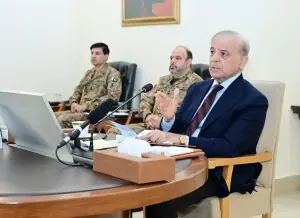
It is, therefore, important to recall that the Prime Minister during his address to the overseas Pakistanis convention challenged independent economists to a debate claiming that his policies are bearing fruit. The word ‘misguided’ used by the honourable chief justice of the Islamabad High Court with respect to the Prime Minister (in relation to highly controversial PECA Ordinance) comes to mind and one would hope that he engages with some independent but highly informed economists to come up with a more informed picture of the state of affairs.
Copyright Business Recorder, 2022






















Comments
Comments are closed for this article.