


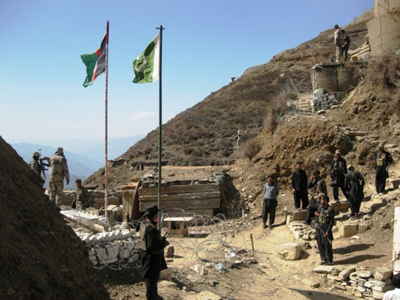
 The military officials of Pakistan, Afghanistan and US-led coalition forces have met now giving credence to reports that back-channel contacts over the last one month or so have helped thaw the ice that had beset Pak-US relationship in the wake of the Salala incident. The meeting at Torkham on Wednesday is said to have discussed and improved various border co-ordination measures, apparently to revert the repeat of that incident in November last year in which 24 Pakistani soldiers lost their lives. Though American leadership has yet to offer unconditional public apology for the 'deliberate, unprovoked' attack, reports from various sources indicate perhaps that may happen now. In fact as the Afghan war enters its endgame scenario, the ground-realities are undergoing critical metamorphosis. Of course, the United States' position on drone strikes, remains unchanged - in fact it has even hardened with President Obama now openly admitting these operations inside Pakistani territory, but no less important are its moves to bring normalcy to its ties with Pakistan. And, as for Pakistan, for it the ground-realities have also registered dramatic changes. Pakistan cannot be unmindful of some moves, like the Taliban-US caucus in Qatar, and would see to it that it remains in the loop. No wonder then, that even before Pakistan's position on issues like resumption of Nato supplies is firmed up and made public by the slated joint session of parliament, Defence Minister Ahmad Mukhtar and Foreign Minister Hina Rabbani Khar have left no one in doubt that supply routes would be reopened. Apparently both, the Pakistan government and the Obama administration feel the need to restore normalcy in their bilateral relationship, of which in the present context their anti-terrorism co-operation is high on their priority agenda. Despite its successful launching of the Qatar dialogue the United States and its allies have no choice but to ensure Pakistan's co-operation for their relatively peaceful withdrawal from the border areas in Afghanistan. Meanwhile, Pakistan has been able to strengthen its diplomatic position not only by reviving contacts with Kabul but also by drawing Iran on its side. The Pakistan-Iran-Afghanistan trilateral summit in Islamabad, next week, is definitely a clever move as it has all the visibility of a counterweight option with Islamabad. Given that Pakistan reacted to a Salala strike with full force - in that it cut off Nato supplies, boycotted the Bonn conference, closed the Shamsi base and said no to the Grossman visit, its capacity to use diplomatic leverage cannot be minimised. But it is also a hard fact that Pakistan's relationship with the United States is multifaceted, ranging from political to economic to military. It would be naïve to think that the two can do without each other. Then there is Pakistan's consistent effort to maintain and strengthen its bilateral ties with Afghanistan, which do get hurt when transit facility to this landlocked neighbour is curtailed as a vicarious outcome of Islamabad's decision to block the Nato supply route. Given this backdrop, Pak-US ties are likely to improve, but not in a way and to a degree as they were before the Salala incident. The reasons are many; for one the concessions a dictator gave to the Americans are no more possible. Already loud protests are being made to preempt the reopening of the supply route, ironically, by the same very forces that were then part of the dictator's team. There is also the issue of drone strikes, which the United States would not like to halt, given its evaluation that these have proved an effective weapon with what they argue minimum collateral damage. Pakistan's stand on that issue remains dubious. Not that Pakistan would like to walk out of this co-operative mode, but it would like to have clear and unambiguous terms of engagement. How to go about border co-ordination and when should a drone strike take place are two main subjects that Pakistan would like to settle with the United States. Pakistan would like to have a kind of veto on the use of drones, which is possible through closer intelligence sharing. Hopefully, later this month when Centcom Commander General James Mattis meets Army Chief General Kayani, some tangible progress would be made in firming up the terms of engagement - a possibility for which environments have considerably improved. Copyright Business Recorder, 2012
























Comments
Comments are closed for this article.