


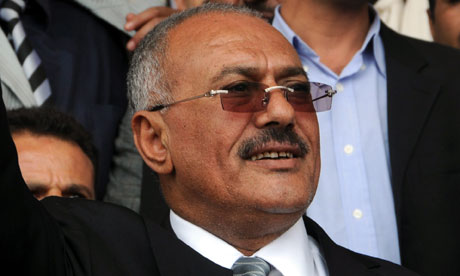
 One of the Arab world's most durable dictators, President Ali Abdullah Saleh of Yemen, flew out of Sanaa Sunday on way to the United States, leaving behind a country teetering on the brink of total economic disaster yet bubbling with its people's determination to recover and rebuild. He should have left much earlier; sometime in April last year when the GCC brokered a deal for his safe exit or shouldn't have returned from Saudi Arabia where he was treated for serious injuries he had suffered in a rocket attack at home. But he did return, like the others who too resisted till the winds of the Arab Spring acquired strong enough force to uproot these long-lasting dictators from their very roots. That Ali Saleh kept his people guessing even when he had already gone by an hour or so - his struggle to remain in power was indeed phenomenal. During his 33-year despotic rule, Yemen, was completely stripped naked of anything and everything called the national wealth, as about 28,000 protesting Yemenis were killed by his forces. And of all the places he has been 'invited' to be the Americans' guest - though the State Department is saying that he would be in the United States only as long as his medical treatment warrants. Rightly then the political opposition has resented the American hospitality which they say is more a gesture of appeasement to the Gulf royalties than a salutation to the democratic spirit of the people of Yemen. And what a safe passage to the dictator: he was granted "complete" immunity by the parliament against prosecution. Add to this his 'farewell' address promising he would return to lead his General People's Congress (GPC) party, the deal that secured his stepping down from power has been rejected by the people. No wonder a leader of the youth who led anti-Saleh protests has promised more protests "until all of the revolution's goals are achieved". The fact is that under this deal only Ali Abdullah Saleh has stepped down while his party infrastructure remains intact and his family and aides are allowed to retain their political clout and enormous wealth. If a dictator is given a warm send-off with no threat of accountability he would nurture hopes of coming back; something we are getting familiar with in the wake of our own experience - ex-president General Musharraf says he would return and contest elections. Whatever may be the understanding of the deal-makers about Ali Saleh's political ambitions the people of Yemen remain sceptical, as much as Nobel Laureate Tawakul Karman has demanded freezing of his and his family's assets. May be the promoters and brokers of the deal feel the removal of Ali Saleh from his presidential office is enough, but not the world outside including the United Nations, Human Rights Watch and Amnesty International, which called it "a smack in the face of justice". The challenge to restore normality following revolutionary changes triggered by the Arab Spring remains, expectedly, enormous and difficult to manage. To tackle it, it demands of the new incumbents of state power to behave more responsibly, as much as the outsiders need to accept the results with an open mind. No doubt to the outside world the ongoing revolutions in the Muslim countries stem from liberal platforms and therefore should be clearly Western in its essence. But that is not happening; in Egypt the electorate has thrown up Islamist parties like Muslim Brotherhood and the Salafists into the cast of future rulers of their country. And rightly so - politics in predominantly Muslim countries cannot be severed from the enduring undercurrent of devotion to Islam. If being anti-secular but corrupt dictatorships means the rise of 'political Islam' and to consider that development as the rise of radical groups like al Qaeda would be a grievous mistake. The Arab Spring marks a new Arab order 'based on respect for nationalism and moderate Islam'. Pity, the deal brokers haven't grasped the essence of Arab Spring as they tend to figure it out in the shadows of their own fears and apprehensions. Copyright Business Recorder, 2012























Comments
Comments are closed for this article.