


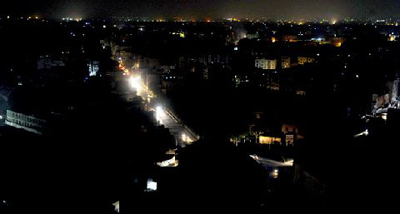
 According to a Business Recorder exclusive, the Finance Ministry's inability to arrange funds to retire part of the inter-circular debt thereby enabling Pakistan State Oil to import fuel critical for power generation would lead to an escalation of scheduled and unscheduled loadshedding. This state of affairs, is an adequate reflection of flawed policies in several relevant ministries. The Ministry of Finance must be held accountable for its failure to implement reforms designed to increase the tax to Gross Domestic Product ratio. In 2010-11, Pakistan's tax-to-GDP ratio actually declined under 9 percent and is a reflection of the poor performance of the Federal Board of Revenue (FBR), under the jurisdiction of the Ministry of Finance, in meeting this overarching objective under the World Bank-funded Tax Administration Reform Programme (TARP) - funds which incidentally would have to be repaid thus increasing the country's overall indebtedness. Additionally, the fiscal deficit in the 2011-12 budget announced by the Minister of Finance is unrealistic as external resources under programme lending, estimated at 117 billion rupees, are unlikely subsequent to the suspension of the International Monetary Fund programme that led other multilaterals and bilateral donors to withdraw their support for programme lending, limiting it to project lending alone. The likelihood of a provincial surplus in the aftermath of the dengue crisis as well as the 2011 Sindh floods estimated at 125 billion rupees is almost zero. In short, the government would have a shortfall of 245 billion rupees from these two identified budgetary revenue sources alone, with implications on its cash in hand and therefore its ability to deal with the liquidity crisis in the energy sector. The 2011-12 budgetary allocation for the Water and Power division under the Public Sector Development Programme (PSDP) was 36 billion rupees and Wapda was to be allocated 72 billion rupees which, there is a consensus, is grossly insufficient to meet the country's continuing severe energy shortage. Given that the ministry has traditionally supported a slash in PSDP as opposed to cutting current expenditure to render its budget sustainable leads many to argue that the earmarked amount, like in 2010-11, is unlikely to be disbursed. The Ministry of Water and Power is guilty of failing to put its own house in order fourth year running. The inter-circular debt continues to be a major impediment to the ability of the sector to operate at maximum capacity due to continued failure to enforce payment of all electricity bills as and when they fall due with the worst offenders being ministries/government departments/Federally Administered Tribal Areas etc. The government has been mulling over a proposal to either disconnect or to cut the payment at source (Ministry of Finance). However, no decision has been implemented in this regard. Thus it is fairly safe to conclude that if the government follows a policy dedicated to eliminating the circular debt through enforcing payment of bills, the liquidity problems facing the sector would ease and thereby reduce the number of hours of loadshedding. The Ministry of Water and Power has also not launched a drive to reduce the line losses, which are well above the international level as well as the regional level. And finally no action has been taken to support comprehensive and cohesive energy policies that would be possible if the Ministry of Energy is created as opposed to having a Ministry of Water and Power, and Ministry of Petroleum and Natural Resources. The nature of the problem is understood by the ministries and government departments and the prescriptions necessary to deal with the ongoing crisis are also known. However the will to implement these reforms has been lacking and it is unfortunate that the government has relied solely on raising rates that account for higher bills with a declining number of hours of supplied electricity leading to violent street protests. Surely in the interest of its political future, a more responsible and appropriate policy needs to be adopted. Copyright Business Recorder, 2012




















Comments
Comments are closed for this article.