


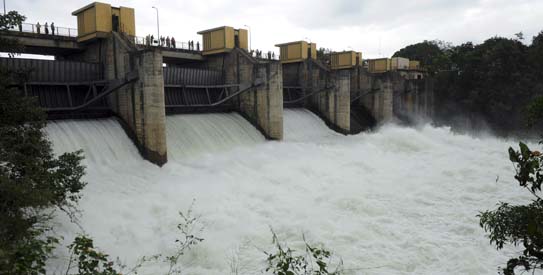
 Islamabad has woken up rather late in the day to challenge, in the International Court of Arbitration, a decision of the UN Framework Convention on Climate Change (UNFCCC) to grant carbon credit to India on the controversial Nimoo-Bazgo hydropower project it is building in Occupied Kashmir's Leh district over Indus River in violation of the Indus Water Treaty of 1960. An inquiry ordered recently by the water and power ministry wondered how India was able to get carbon credit benefits for this project in view of the fact that it is located on trans-boundary water, for which ratification of the parties concerned should have been procured beforehand under clause 37(b) of UNFCCC. The UN agency clearly needs to remedy the situation. That though does not let off the hook concerned officials within Pakistan for blundering all through, right from the time information about the project came in nearly a decade ago, ie, in 2002. It took almost seven years for Pakistan's Commissioner for Indus Waters (PCIW) to put the project on the Permanent Indus Commission's agenda. The said inquiry report has placed the entire blame at the door of the now retired commissioner Jamaat Ali Shah, saying he could have acted early on and asked the authorities "to approach the court of arbitration/neutral expert at that stage" but he did not do so. It also expresses surprise that "disputes/differences on design/carbon credit benefits were handled in a casual manner" whilst the media and intelligence reports were carrying sufficient information to raise objections with India. As the situation stands, much precious time has been wasted. The 45MW hydropower project on Indus River, which as per the Indus Waters Treaty, falls within Pakistan's share of rivers, is almost near completion and scheduled to be commissioned in July of the current year. Still, if Pakistan pushes hard enough it may succeed in getting rectified at least some of the five objections it has raised to the design of the gated spillways and depth of the dam in accordance with the Indus Treaty. It should not be so difficult to get the carbon credits revoked considering that the UNFCCC approved them for a trans-boundary project without getting the necessary clearance from Pakistan on the basis of its own environmental assessment report. No contest from Pakistan does not mean acceptance. The issue, nonetheless, threatens to take on a scandalous colour given that officials in Pakistan are alleging that the Indian government "misled the UN agency through fake and fictitious documents that might have shown Pakistan's consent to the project because there was no such record available in Pakistan." Whatever happens at the FCCC the controversy also shines a light on a sad reality at home: that all the concerned ministries - water and power, foreign affairs, and environment - are narrowly focused within their respective domains. Presumably, the PCIW shared his failures and frustrations with the ministry of water and power, which should have taken up the two issues pertaining to the controversial project to the other relevant ministries. He may have messed up things, but it seems others did not do much either to protect and preserve Pakistan's interest. Copyright Business Recorder, 2012























Comments
Comments are closed for this article.