


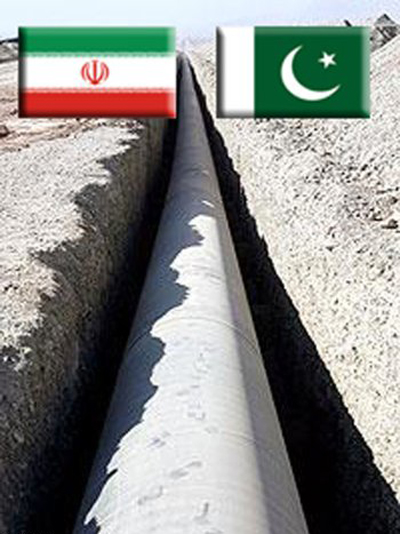
 The Economic Co-ordination Committee (ECC) of the Cabinet, the highest economic decision-making body in the country, has approved in principle the appointment of a consortium led by Industrial and Commercial Bank of China as financial advisor of the Iran-Pakistan (IP) gas pipeline project. Not surprisingly for those who have been following progress on the IP gas pipeline, the same day the US State Department spokesperson, Victoria Nuland, noted that the IP pipeline could violate US restrictions on major financial deals with Tehran and added that "We've made absolutely clear over many months now our concern about this deal and we will continue to talk to Pakistan about it. Were it to go forward, how it might be impacted - again, this is the kind of conversation that we have to have with Pakistan and that we're starting to have now." Prior to getting euphoric over the ECC decision it maybe appropriate to look at the history of this hapless pipeline that clearly is to the benefit of the countries concerned. The IP was first conceived in the 1950s when Malik Aftab Ahmed Khan's article on the subject was published by the Military Engineering College, Risalpur. In 1989, the project was conceptualised by Rajendra Pachauri and Ali Shams Ardekani, the then Deputy Foreign Minister of Iran. Discussions between Iran and Pakistan commenced in 1994 and a preliminary agreement signed in 1995. Four years later, Iran and India signed a preliminary agreement. In 2007, India and Pakistan agreed to pay Iran US $4.93 per million British thermal units (US $4.67/GJ), a price that Iran upgraded. In 2009, India withdrew from the project over pricing and security issues, and after signing a civilian nuclear deal with the US in 2008. In January 2010, the United States requested Pakistan to abandon the deal and in return receive assistance in construction of a liquefied natural gas terminal and support in Turkmenistan-Afghanistan-Pakistan-India (TAPI) gas pipeline project. The foregoing reveals two major elements that have delayed the implementation of the project. First, the Iranian decision to upgrade the price agreed. This, Dr Asim Hussain recently revealed, is no longer relevant for Pakistan given the massive rise in the international price of alternate fuels as well as a massive gas shortfall in Pakistan contributing to a severe ongoing energy crisis. And second, India's perceived security concerns with respect to Pakistan as a transit country and for the US in terms of its own historical tensions with Iran that have recently further escalated. India has dropped out of the deal and hence is no longer of relevance to the pipeline's implementation. The US remains a player in Pakistan and this is in spite of the post-Salalah checkpost attack by Nato forces in November last year that led to tensions between Islamabad and Washington. However, Nuland in her press briefing admitted that Pakistan had not received any money under Coalition Support Fund since June 2010 and only 400 million dollars out of the 1.5 billion dollars approved under the Kerry-Lugar bill during 2011. Thus, the US leverage has clearly declined as a consequence. Does the ECC decision indicate that the US leverage is no longer a factor in the IP pipeline? President Zardari on the occasion of the fourth death anniversary of his spouse noted that his government must not be pressurised into deciding who to trade with - a statement that many argued was in reference to the ongoing US opposition to the IP pipeline. Thus the ECC decision clearly is in accordance with the wishes of the President. In addition, however, great US influence on international trade relations maybe US sanctions are not the same as UN sanctions. And without doubt, Pakistan has been suffering from the ill-effects of severe energy shortages that have not been compensated through US assistance. It is not known whether the government would proceed as planned, what is, however, known is the fact that the situation poses profound questions and troublesome problems in relation to country's growing energy needs. Copyright Business Recorder, 2012























Comments
Comments are closed for this article.