


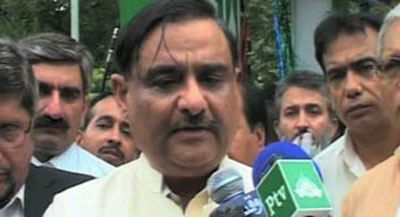
 Minister for Petroleum and Natural Resources Dr Asim Hussain has stated that he would visit India next month with the objective of negotiating the transfer fee for Turkmenistan-Afghanistan-Pakistan-India (TAPI) gas pipeline project. A word of caution to those who may consider this as an indication that the project is nearing implementation: according to the project's main sponsor the Asian Development Bank (ADB) as noted on its website, the perceived risks of the 225,000 dollars technical assistance phase II are: (i) non-conformance of any of the governments to hold the meetings; (ii) change in governments' priorities; and (iii) insurgencies or external conflicts. However the Bank adds that the participating governments' active participation in the Technical Working Groups (TWGs) and steering committee meetings, coupled with exchange visits of top-level officials, reflect their commitment to developing a common approach to various bilateral and multilateral issues in realising the project. The ADB also noted progress towards the outcome as follows: the ADB held the TAPI's Buyers/ADB and Seller/ADB Meeting on 10-12th January 2011 and 24-26th January 2011, respectively. The ADB likewise facilitated the GSPA negotiations and agreements on the 10th-15th TAPI TWG meetings between mid-February and late-July 2011. The GSPA is currently being finalised for signature of Turkmenistan, Afghanistan, Pakistan and Indian parties by September 2011. On November 14, the government of Pakistan and Turkmenistan signed the GSPA. That the project represents a win-win situation for all participating countries is not in dispute. It envisages an initial capacity of 27 billion cubic meters (bcm) of natural gas per year of which 2 bcm will be provided to energy-deficient Afghanistan and 12.5 bcm to India as well as 12.5 bcm to severely energy-deficient Pakistan. Later, the capacity will increase to 33 bcm. Pakistan like Afghanistan would benefit enormously from TAPI not only in terms of meeting our energy requirements but also in terms of generating considerable revenue through charging a transit fee. Be that as it may, Pakistan is expected to pay a transit fee to Afghanistan as well as collect it from India. Documents reveal that the project sponsors initially considered 200 million dollars per annum to Pakistan as an appropriate transit fee though the amount is no doubt subject to negotiations; however one would assume that Dr Hussain would be accompanied and guided by the project sponsors in his meetings in India with respect to the transit fee. This brings to mind the approval extended by the government of Pakistan to allow goods trade between India and Afghanistan to use Pakistan as a transit country. Surprisingly, the government of Pakistan has not considered the levy of any transit duty to this trade which would use our roads without paying any tolls that could be earmarked for road maintenance necessitated by the heavy vehicular traffic expected when trade commences. The question is obvious: if the government can and does expect India to pay for using Pakistan as a transit country for gas then surely the same principle must apply to the use of our roads which are more susceptible to depreciation than the gas pipeline. Within this context, it is also relevant to identify which ministries must be compelled to act in concert to come up with proposals that would allow us the maximum leverage possible in our dealings with other countries. Had the Commerce Ministry and the Petroleum and Natural Resources Ministry decided to work together to deal collectively with our economic ties with India then our leverage would have been greater and India may have been more easily convinced to pay a transit fee for transport of its goods through our borders as well as the transport of gas through Pakistan. One must acknowledge the skilful way in which India linked approval of MFN status to withdrawing its objections to EU proposals and one would hope that we have learned some lessons from it. Copyright Business Recorder, 2011



















Comments
Comments are closed for this article.