


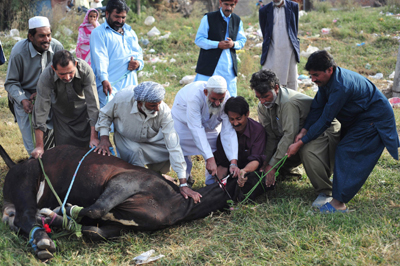
 Today Muslims in Pakistan and some neighbouring countries celebrate the Islamic calendar's second-most important festival, Eid-ul-Azha, in the great Ibrahimi spirit of sacrifice. Earlier, faithful from all over the world gathered in Makkah (which is a day ahead of Pakistan as per the lunar calendar) to perform Hajj following the example of Prophet Ibrahim (AS). This Eid commemorates the occasion when Prophet Ibrahim (AS), answering God's command, had travelled to Mina to construct the holiest of holy places, the Ka'aba, and to sacrifice his son's life. As he sat down to make the sacrifice, God replaced the boy with a sheep. Hence, the ritual of sacrifice that many will perform today is about surrendering before God something valued, not to show off affluence as many tend to do. The occasion is about sharing, too. Those who can afford will sacrifice goats, sheep, oxen, and camels, distributing meat that, in accordance with religious obligations, is to be divided among family, friends, neighbours and poor people. The largest share has to go to the poor, who cannot afford it otherwise. This is all the more important these days since meat prices have skyrocketed. Many though neglect the poor and distribute the meat among equals or higher-ups to promote PR. Others lament that people waste a lot on this occasion. They take exception to people slaughtering several animals in an individual's name, arguing that it should suffice to sacrifice a single animal to emphasise the day's symbolic significance. The wastage aspect is there, but then it is an occasion of general celebration when such over-indulgences can, perhaps, be ignored. It is difficult not to remember here that this year's Eid-ul-Azha has come at a time when a large part of the Muslim world is in deep turmoil. In the Arab Spring, which started in Tunisia and spread to most other Arab countries, thousands have sacrificed their lives so that their fellow citizens could have a better future, free from oppression and exploitation. So far only the Tunisian struggle for democracy has culminated in a free and fair election. Egyptians, despite having made tremendous sacrifices, still face an uncertain future. Libyans have triumphed over their authoritarian regime, but seem to have little control over what may lie in store for them in the days to come. The Bahrainis, hundreds of whom gave their lives for freedom and democracy, are confronted by the regime's retributive wrath. In Syria, over three thousand people have sacrificed their lives in an ongoing struggle against an oppressive regime. As people in most other Muslim countries celebrate the festival of sacrifice, they should spare a thought for those sacrificing their lives so that others can live in peace and prosperity. Copyright Business Recorder, 2011






















Comments
Comments are closed for this article.