


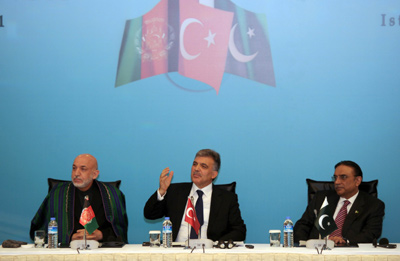
 Now when the Nato-led coalition forces are preparing to vacate Afghanistan, there is the concern that short of putting in place a matching space-filler, the Afghan resistance would take over Kabul and then the rest of the country. Something like this had happened earlier when in the power vacuum that came into being following the Soviets' sudden departure, the Mujahideen forces quickly stepped in, but furiously fought over the war booty paving the way for the Taliban takeover. Despite the coalition's best efforts and costly investment over many years, that kind of vacuum exists in Afghanistan, as various plans and programmes bankrolled by the international community haven't succeeded in creating a self-sufficient national security system. Going by the draft circulated earlier as its mission-statement the Istanbul Regional Conference held this past Wednesday, was expected to create a new security arrangement to fill the space to be vacated by the Nato-led coalition forces. However, the declaration issued after the daylong deliberations makes no such revelation, though no words have been spared in committing to 'join hands to ensure peace, security, development and prosperity in Afghanistan'. Perhaps, the organisers' purpose was only this much, and that the task of creating a security arrangement has been left for the 'Bonn-10' conference next month. Do we really need yet another regional security-oriented arrangement; Pakistan has expressed its doubts. Not only it questions the rationale of one more regional security outfit when several, including SCO and ECO, and sub-regional trilateral and multilateral forums already exist, Foreign Minister Khar reiterated that position at the Istanbul moot also. Underscoring the need to make best use of what is already there on the ground in terms of regional security imperatives, she rightly pointed out that Pakistan is always the first to benefit/suffer collaterally from developments in Afghanistan. Pakistan is opposed to a permanent military base in Afghanistan following the Nato pullout or substitution of coalition trainers by those from a hostile regional power, and this was made abundantly clear to the hosts of the conference. A peaceful and stable Afghanistan remains Pakistan's top priority, for no other country has suffered so much as Pakistan as result of the chaos and anarchy in that country. If India boasts of planning to spend 2 billion dollars on development in Afghanistan and if the United States and its allies are fighting to contain and defeat terrorist forces within that country, the price that Pakistan has paid in the past and is paying even now for the Afghan imbroglio too should be figured out. Let somebody quantify the costs Pakistan has incurred by hosting three million refugees for three decades, or the price it has paid in terms human or economic losses. That President Karzai didn't hesitate in maligning Pakistan at the Istanbul conference only a day after having a very useful meeting with President Zardari in the same Turkish city - was not expected. He said he would not talk to the Taliban - as against the Americans' perspective that a negotiation with insurgents is now their best option. How come the conference couldn't propose a kind of roadmap for Afghan reconciliation which remains incomplete without the participation of the insurgents? How can the Afghan reconciliation process be 'Afghan-led, Afghan-owned and Afghan-driven' without Taliban being part of it? However, that said, it would be unfair not to define the Istanbul Process as a significant departure from the UN-mandated intervention, which opted for war in Afghanistan instead of a political approach with the Taliban who were then a reality as they are now. The CBMs package approved by the conference may not be as easy to materialise as easily spelled out, but the very act of adopting it is indeed a significant departure from the present war-centric foreign intervention. Accepting the ground realities in Afghanistan, will the forthcoming Bonn conference take further the reconciliation process by involving all segments of Afghan society, and not become once more an instrument of foreign intervention - the world will watch and wait. Copyright Business Recorder, 2011






















Comments
Comments are closed for this article.