


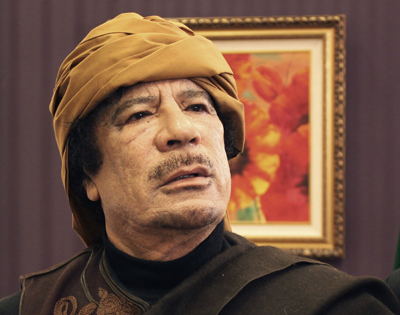
 Colonel Muammar Qadhafi came riding a revolution and has left fleeing a revolution, after dancing on the world stage for 42 years much to the amusement and chagrin of the bewildered audience to whom he presented himself as an admixture of arrogance and appeasement. With his killing on Thursday morning as he broke out of his besieged hometown Sirte apparently by the revolutionaries as he lay wounded by a Nato air strike the Arab Spring has arrived at its defining moment. At the end of eight-month old civil war in Libya ending in the death of Colonel Qadhafi, one of the most durable dictators, the Arab world appears ready to accept the fact that its dictators' days are counted, and not too in distant future this part of globe would be in the hands of its people. Much deep though Yemen's tyrant Ali Abdullah Saleh may dig his heels and how shrewd may be Syria's despot Bashar al-Assad they have to go now. On September 1 1969, the 27-year-old Colonel Qadhafi deposed an aging and ailing King Idris to the utter delight of the Arab world that was then recovering from a long spell of colonialism. Ushering in a revolution portrayed as pro-Arab, pro-Islam and anti-West with pronounced socialist leanings lent him the opportunity to stand in line with the Third World heroes such as Egypt's Gamal Abdel Nasser, Cuba's Fidel Castro and others. But over the time, he squandered this status and became an international madcap. Now that Qadhafi is gone and Libya has been 'liberated' the question is: How soon will the six million Libyans have the right to elect their own government, enjoy fundamental rights of freedom of expression and control over the use of their oil wealth? Of course, the leaders of the National Transition Council (NTC) have promised to set in motion transition to democratic elections as soon as Libya is "liberated", which has virtually happened now with the fall of Sirte, Qadhafi's hometown, though some pockets of resistance in the south and west of the country will remain active for some more time. Will the present NTC be able to transform itself into a transition government within 30 days as promised, which in turn will set up a 200-member National Council? Will the National Council write the constitution and hold elections within eight months? This is indeed a huge challenge given the verdict of history such a clean handover by the revolutionaries is not possible, also for the reason that the rupture caused by a dictator's fall impedes quick return to normalcy. Given the lingering contention between the liberal and religious factions of the revolutionaries, competition for power in Tripoli between the tribal leaders and city-bred politicians, and above all the conflicting interests of some of Nato powers over the control over Libya's oil industry, the post-Qadhafi Libya is not likely to settle down to a peaceful and stable existence as soon as one would hope. If peace and stability still remains alien to the so-called liberated Iraq and Afghanistan what is it that would ensure a peaceful, functional democratic Libya in foreseeable future? While the West has promptly reacted to the demise of Qadhafi, with the United States describing his departure as 'lifting the dark shadow of tyranny,' the others in the international community don't seem to be in hurry to do so. And, if Pakistan is from the latter group it is for the divided opinion and resultant confusion stemming as much by our 'historical' relationship with the late dictator as for the contempt the people of Pakistan have for despotic rule. The Pakistan government resisted according recognition to the NTC while the people were for it, may be for the great friendship between Zulfiqar Ali Bhutto and the ousted Libyan dictator which had come to full expression at the Islamic Summit in Lahore in 1974. Pakistan under ZAB, he said, was "fortress of Islam". And when General Zia took over in a coup against the PPP government Libya snapped diplomatic relations with Pakistan. That Libya bankrolled Pakistan's nuclear programme there was no evidence to that assertion; nor was there any evidence to substantiate allegation that millions of dollars were deposited in our government's account. There is an historical perspective to the Nawaz Sharif's call for immediate recognition of new Libyan government also. In 1991, during his visit as prime minister, Colonel Qadhafi's attitude was so offensive that the Pakistani delegation abruptly left Tripoli. But the bilateral relationship hit the rock bottom during General Musharraf's government when the maverick ruler passed on to Americans some fake and fabricated information on Pakistan's nuclear programme, as an appeasement to treat his son Seiful Islam as his legitimate heir to power. Now that a New Libya has come into being Pakistan needs to revisit its diplomatic relations and recover its position as Libyans' friend and brother. There is a lot more that the two countries can share and build together in terms of economic and political co-operation. Copyright Business Recorder, 2011




















Comments
Comments are closed for this article.