


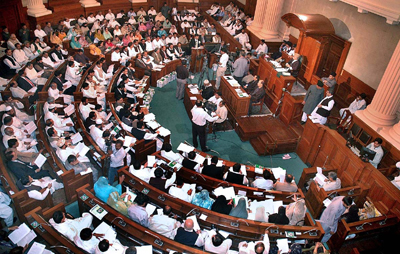
 Even when natural calamities and man-made disasters refuse to relent on causing immense hardship to the people, our political elite appears to be least concerned, engaged as it is perpetually in the polemics of politicking that keep it in the news. What we have as the latest in this specialisation is a statement by Tahir Ali Javed, a leader of the so-called Unification Bloc in the Punjab Assembly. He says he would be shortly advising Chief Minister Shahbaz Sharif to seek the dissolution of the provincial assembly, and that done, early general elections would become unavoidable. No surprise his proposal falls in line with the broad thinking of the PML-N leadership - only the other day Nawaz Sharif told his audience in Sindh that his party would like to have snap elections even at the cost of the Punjab government. However at present, the party has not welcomed Tahir Ali Javed's idea, insisting it has no such intention and that what the Unification Bloc member said may well be his personal opinion. But given the complexity, and the accompanying viciousness of the power struggle in the province of Punjab, one would be profoundly naïve to rule out the possibility of such a call by the chief minister at some point of time. He has the constitutional right to advise the governor to dissolve the provincial assembly, and "unless sooner dissolved, (it shall) stand dissolved at the expiration of 48 hours after the Chief Minister has so advised." There are no ifs and buts that the PPP critics have hinted at in their reaction to Tahir Ali Javed's suggestion. Once dissolution of the assembly is sought by the chief minister, it has to be done - as simple as that. Will such a move cause a postponement of elections in March next year to the vacated seats of the Senate? That it would not be so. Of course, there is no clear provision in the Constitution to deal with a development as envisaged by the Unification Bloc member, but the burden of case law and expert opinion support the opposite, in that the non-availability of a part of the electoral college for electing the upper house does not stand in the way of its election. In a similar situation, the Indian Supreme Court upheld the argument that the non-existence of a state legislature should not be a ground for postponement of the election to the upper house. Being a symbol of the federation, where the federating units have equal representation, the Senate of Pakistan does not put up with reasoning like the one that Tahir Ali Javed made saying that as Punjab is 60 percent of Pakistan, without its participation there could be no election to the upper house. But that is not going to happen, and the likely scenario would be in case of inability of the province of Punjab to send replacements, the upper house would be incomplete till the new provincial assembly is elected, which would then elect the new senators. But one is certainly intrigued at the intensity of interest that the political parties are showing five months ahead of the elections to the seats that would be vacated in March next year. Not only is the PML-N not worried about losing more turf to the ruling coalition, the PPP leadership is also burning the midnight oil to curry favour of other parties for support. Prime Minister Gilani is supposed to have been tasked by President Zardari 'to use all available resources at his disposal' to muster support for the Senate elections. By all accounts the eyes of the PPP leadership are set on gaining a simple majority in the upper house on its own and an absolute majority with the help of its coalition partners as the provincial components would elect 54 senators in the house, whose strength has been raised from 100 to 104 under the 18th Amendment. Of course, all of this correctly falls within the recognised confines of the democratic process, and if the PPP emerges still stronger from the Senate elections, so be it. But this is also a fact that too much of politicking, as seems to be the case presently, does not sit well with the general masses, who are confronted with problems of biblical proportions and there is no hope of relief any time soon. So, is it not a cruel paradox that politics done in the very ambience of constitutional democracy should keep the people's lingering plight and misery out of the sight and mind of their elected leaders? Copyright Business Recorder, 2011





















Comments
Comments are closed for this article.