


Economic Prosperity in days instead of years and months: Pakistan has projected an estimated budget of Rs 2.7 trillion for the current fiscal year 2011-12. Unfortunately by the conclusion of the fiscal year actual expenses will exceed Rupees 4,000 Billion. In fact, generation and collection of revenue inclusive of Tax Revenue (including income tax, sales tax, duties, surcharge etc) and Non-Tax Revenue never surpasses the mark of Rupees 3000 Billion. The annual average budget deficit for last five years was not less than Rs 700 to 1000 billion. The question arises then how does the government cover this shortfall.
Government has the following budgetary and non-budgetary supports available to balance this deficit:
i. Prints money without having adequate reserves resulting in inflation and devaluation of currency.
ii. Prints prize bonds, treasury bonds and saving certificates and sale these instruments through banks and other government agencies. These carry high interest/yield rates and increase public borrowings and increase in internal debts.
iii. Buys foreign currency (USD) from open market to cover the shortfall in foreign exchange of approximately 2 to 3 billion Dollars every year.
iv. Borrows fresh loans from IFI's like IMF, ADB, World Bank etc It is claimed that interest rates are very competitive nevertheless these loans and interest thereon has to be paid, consequently external debt increases every year.
v. Borrows from banking system and hardly pays back. These debts increase every year, as government is unable to even pay interest on the borrowings and reschedule these loans.
vi. Government controls the prices of vital commodities like petrol, electricity etc and services. To reduce the budget deficit, increases price of such commodities, which adversely affect the cost of goods produced or imported in Pakistan. Such devastating rise in prices has worse impact on economic activities and increases input cost manifold. Resulting into higher cost of merchandise for domestic consumption and international market as well. This also widens the trade gap between imports and exports, which is currently estimated at 12 billion Dollars. Now we are presenting Bedar Pakistan budget total amount of 20 trillion Rupees.
This will eliminate poverty, cost of living will reduced to less than 50%, and special pay award to all the government servants. Minimum wages will be at least 25,000 rupees per month with special attention given to immediate relief of power and water shortage. It will give a kick start of dying industry of Pakistan and massive employment opportunities in the range of 5-6 million peoples will employed within the shortest period of one month.
Improved Conditions for Private Sector Participation
Private investment can play a significant role in supporting sustained economic growth. A vigorous private sector drives economic growth, but government plays a vital role in creating a climate where entrepreneurship can flourish. An improved business environment not only delivers higher and more productive private investment, it also expands the private sector by establishing a level playing field encouraging small businesses (often the most dynamic business segment) including a shift from the informal to formal economy. A better business environment is also essential to attract more foreign investment.
Debt Relief
Debt relief is very important for increasing the fiscal space for much needed increases in spending and to promote growth, poverty reduction and relief from debt overhang. In the fiscal year gross revenue receipts are estimated at Rs 98,750 billion which shall able us to retire all external debts. The repayments and early retirements of all external loans are estimated at Rs 4,963 billion. This shall make our country financially independent and free from the pressures of international financial institutions.
Physical Infrastructure
Private sector productivity and investment rates are severely affected by inadequate level and quality of infrastructure including electricity, transportation and communications. Infrastructure gap reflects that sizable investment is required to bridge this gap which increased due to lesser public investment in infrastructure. Under present circumstances it is likely that such projects initiated by private sector will fill significant portion. In order to improve the physical infra structure following projects are proposed:
1. In order to cover the immediate shortage of electricity especially in urban areas of country, 100 gas turbines, each capable of producing 100 Mega Watts's electricity shall be installed in 10 major cities to lessen the power consumption pressure. Adequate funds are allocated for this project in the budget.
2. Construction of 5 dams in next 5 years to cater the consumption requirement of electricity for next 50 years.
3. Nuclear power stations shall be constructed.
4. Conversion of present 8,163 km long single railway track to dual track and laying another dual track of 1,837 km long.
5. Conversion of 152,033 km long paved highways into expressways of international standards.
6. Conversion of 105,650 km long unpaved highways to paved highways.
7. Construction of 150,000 km long paved highways to connect remote areas.
Basic Amenities
Every child has a right to attend primary school, a place for medicine and basic health care.
Every citizen has the right to have clean drinking water, sanitation. Unfortunately these services are either unavailable or available at poor quality or very high cost. Human development is influenced by various factors like traits, family backgrounds, social features and nation characteristics. The policies chosen by government in respect of education, health, water and sanitation services influence human development.
In order to improve the physical infrastructure following projects are proposed:
1. A sea water desalination plant with a capacity of producing clean drinkable water of 50 million gallons per day shall be constructed in Karachi to make sea water desalinated. This shall provide clean and pollution free drinking water to the residents of Karachi city. The cost of this first mega project of its kind in Pakistan is estimated at Rs 17 billion and shall be completed in 18 months.
2. 200 desalination plants packed in containers shall be installed along with the costal line of Pakistan to provide potable and drinking water immediately to the inhabitants of these regions. The cost of this project is estimated at Rs 2.400 billion and this shall be completed in 3 months.
3. Waste water treatment plants shall be constructed throughout the country to make industrial and municipal sewage water fit for cultivation. Initially these plants shall be constructed in 10 major cities.
4. For every 5,000 persons one hospital shall be constructed throughout the country to provide basic health facilities.
These 30,000 hospitals shall be equipped with all basic and advanced medical equipments and instruments.
5. In order to increase the literacy rate 100,000 primary schools shall be opened. Present middle schools shall be upgraded to high schools.
Challenges on the horizon
While reassured in the efficacy of economic strategy, the government is not complacent by progress achieved and formidable challenges still remain on the horizon. These challenges include the following:
(l) The need to push the growth rate before we can realistically hope to have a meaningful reduction in poverty. For this purpose, significant increase in investment is required, especially in the private sector.
(2) The need to improve human development indicators, which will call for significant increase in social spending.
(3) Public sector enterprises continue to bleed the budget and limit the fiscal space needed for social sector spending. An accelerated restructuring to reduce their losses is essential to contain this menace.
(4) Significant evidence is emerging that indicates that our growth potential is being seriously undermined by lack of adequate infrastructure of roads, water, power, gas and telecommunications. The need for major increase in development spending aimed at rehabilitating and expanding the economic and social infrastructure is extremely pressing.
(5) Lack of desired capacity in the system to fully absorb available investment resources. Implementation and governance bottlenecks, thus, need to be removed with concerted efforts.
(6) Law and order and image are clearly interrelated challenges. A lot to tackle these issues is required.
Agriculture Package
The significance of the agriculture sector in our economy is undeniable. Apart from major contribution to GDP, the sector provides livelihood to nearly 70% of population. More importantly, it houses the largest number of poor people in the country. For all these reasons, development of this sector is central to the well being of our country.
Initiatives are required to be taken in the water sector, which is essentially related to the development of agriculture.
In addition, plans shall be taken for the following initiatives for the agriculture sector:
1. Through elimination of taxes and adjustment in input cost the prices of fertilisers, urea, seeds, and pesticides shall be reduced by 50%.
2. With a view to easing the emerging shortages in the market for tractors and other agricultural machinery and equipment, the import policy shall be revised to allow imports of all equipment, which are not manufactured locally, with no duty. There will be no GST or withholding tax on such imports. This shall be subject to the options available under MBC System. This will not hurt local industry.
3. To ensure cheap availability of credit to agriculture sector, the financial institutions shall provide loans on profit and loss sharing. The profit and loss sharing ratio shall be determined from case to case basis and shall be applicable for all types of new loans and financing of tractors and tube wells etc.
4. The agricultural bank shall be restructured with a view to providing better services to farmers.
5. The package for corporate farming shall be formulated and shall be implemented to gain the benefits of large scale.
6. Private sector banks shall be encouraged to lend to the agriculture sector.
7. Special reservoirs shall be developed on each river to store the flood water in case of floods.
8. New canals shall be made from the flood reservoirs and lakes of the proposed 5 dams to provide water resources to the areas which depend on rainfall. This package will go a long way to enhance farm productivity and incomes of farmers. Since the majority of low income groups are living in rural areas, improved agriculture performance will impact positively on the economic lives of such people.
Package for Industry
The manufacturing sector has enormous scope for the growth. The sector has not responded to the incentives that were offered by the current government, whereby under Mutual Benefit Coupon System the duties on all items of raw materials shall be eliminated subject to the conditions laid down under the MBC System. The MBC System shall abolish all duties of capital goods, raw materials and afford due protection to final products.
Availability of credit on profit and loss sharing basis shall be offered to the private sector. The competitive sharing ratio is the key to the growth of industrial sector. The Government shall maintain the fiscal stance to keep the cost of capital lower and ensure increased availability of credit to the private sector. Some of the proposed measures that government shall take to facilitate the industrial sector areas follows: 1. Removal of intervention of different departments and agencies and liberalising the working of industrial sector. The visits by any department/agency shall be pre-announced with appropriate notice.
2. Improve the enabling climate for private sector by removing regulatory and institutional constraints.
3. Significant relief shall be provided to industry by removal of all types of taxes and levies, which would be helpful in reducing the cost of production and enable our industries to provided cheaper products to consumers.
4. To meet the challenges of new WTO regime, liberal import of machinery, shall be allowed via duty free option. These measures will significantly improve the global competitiveness of our industry by reducing the cost of doing business in Pakistan.
5. To assist the industries to meet the international environmental standards, effluent treatment plants shall be established in all the major industrial estates for which funding support shall be made out MBCS resources.
6. New textile, sports goods and medical instruments cities shall be established that would provide a modern industrial estate with all the utilities and export processing zone facilities.
7. Heavy engineering institutions shall be developed to manufacture modern and hi-tech machinery which shall be helpful in improving quality of finished products.
8. Food processing plants shall be encouraged to be established in areas located near by to fields. Loans shall be provided on softer terms to incorporate plants so that foreign exchange can be earned by exporting processed food.
9. Incentives shall be offered to encourage the export of sea food.
10. Water treatment plants shall be provided to industrial sector on softer terms and conditions to avoid water pollution.
In this budget we have proposed a number of measures both to reduce the burden of taxes on the agriculture and industrial sectors as well as to provide relief to the common man. A very large number of taxes have been either abolished or reduced to provide cheaper machinery as well as raw materials to both agriculture and industry. The development budget has been raised significantly which will help to accelerate the growth process and create more than I million new jobs for our people. We are maintaining fiscal discipline by continuously reducing non-development expenditure. The budget will herald a new era of investment and growth in the country.
Further incentives shall be offered to stimulate growth of private investment in SME, housing and agriculture sectors all of which have the potential to create new jobs.
Import Policy
In order to increase private sector participation in the economic development and to gain their confidence it is suggested that government shall cease its involvement in import of basic necessities like wheat, sugar, petroleum products etc and shall allow private sector to import any thing other than weapons, ammunition, narcotics, liquor or any other item import of which is restricted by the government.
The government shall intervene if private entities make a cartel or pool to drive the market prices and shall make immediate arrangements to flood the domestic market with such things by way of imports.
Budget Estimates
The budget estimates of BEDAR under Mutual Benefit Coupon System together with budgetary performance for the last year are as follows: In the budget 2011-12, a budget deficit of 4% of GDP was projected. We are pleased to mention and are confident that projected performance on this important benchmark of fiscal management shall be positive for the first time in the history of our country. In view of the high growth target for next year, which calls for a much higher development spending, and the fact that a high degree of budgetary discipline has been already been achieved, it is proposed to slightly relax the fiscal constraint.
Gross expenditure under Bedar Pakistan Budget for the year is budgeted at Rs 20,000.00 billion. Of this, Rs 5,657.720 billion are provided for development expenditure, which represents a significant increase in development expenditure for the current year. It will be seen that while containing current expenditure, we have substantially increased development spending.
We are conscious of the needs of country's defence which cannot be comprised for want of resources though such resources are utilised with utmost responsibility and economy. For the year, defence expenditure is budgeted at s.3,000 billion to cater the requirements of the Pakistan Forces and to conduct research and development for ultra hi tech technology.
On the revenue side, during the year, total receipts are estimated at Rs 20,000 billion. Pakistan Monetary Fund (PMF) performance is estimated at Rs 11000 billion. Other revenues are estimated at Rs 9000 billion.
These above estimates indicate that while maintaining fiscal discipline this budget has provided for investment and growth. It will thus serve to consolidate the economic gains already achieved and further the process of accelerated economic development. It will create jobs, provide for improved health, education and population welfare services and stimulate growth investment in the country.
Relief measures The Government is cognisant of the fact that some segments of the society are in need of special relief. Accordingly, a number of relief measures have been adopted in this budget:
Pay Award The Pay and Pension Committee had given its award some time ago. It is the time to give relief to the employees and pensioners of federal and provincial governments. Accordingly, the salaries and pensions of federal/provincial government employees have proposed as follows:
1. Armed forces are responsible for the defence of our homeland. Acknowledging their services the following pay structure of armed forces personals is proposed along with allowances:
-- Sipahi Rs 40,000, • Lance Naik Rs 45,000, • Naik Rs 50,000, • Havaldar Rs 55,000 Naib Subedar Rs 60,000
Subedar Rs 65,000, • Subedar Major Rs 70,000, • Lieutenant Rs 80,000, • Captain Rs 90,000, • Major Rs 1,00,000
Lieutenant Colonel Rs 1,20,000 Colonel Rs 140,000,
Brigadier Rs 165,000
Major General Rs 200,000
Lieutenant General Rs 250,000
General Rs 350,000
An increase of Rs 10,000/- p.a. in salary is also proposed.
2. Police is responsible for good law and order situation in country. In order to facilitate police the following pay structure is proposed:
Constable Rs 40,000
Head Constable Rs 45,000
Assistant Sub Inspector Rs 70,000,
Sub Inspector Rs 100,000
Inspector Rs 175,000,
DSP/ASP Rs 250,000
SP Rs 300,000
SSP Rs 350,000
DIG/AIG Rs 450,000
IG Rs 600,000
An increase of Rs 10,000/- p.a. in salary is also proposed.
3. In order to provide justice the system of judiciary shall be restructured. Lower courts shall be bound to decide each case within 3 days in order to: provide justice without any delay. This shall also eliminate the culture of adjournments/dates and the rightful shall have their rights in time. The courts shall be equipped with close circuit cameras and daily proceedings carried out by the court shall be recorded. In case of appeals before higher courts these tapes shall be provided to the higher courts for basic evaluation of cases.
Each district shall have their own high courts and supreme courts which shall be independent. Appeals against decisions of high courts shall be transferred to supreme courts of different districts in order to avoid any sympathetic or favourable action.
The salaries of judges shall be as follows:
Judges of Lower Courts Starting from Rs 500,000
Judges of High Courts Starting from Rs 750,000
Judges of Supreme Courts Starting from Rs 1,000,000
Besides salaries the judges shall also be entitled for an incentive for each case, if decided in stipulated time frame, provide that the higher courts retain the same decision in case of appeals.
The incentives proposed are as follows:
Judges of Lower Courts Rs 10,000, Judges of High Courts Rs 15,000, Judges of Supreme Courts Rs 20,000
4. Salaries of other employees of federal and provincial governments are proposed as follows along with allowances:
Peon/Naib Qasid Rs 25,000
Clerical Staff Starting from Rs 40,000, • Grade 16 Starting from Rs 100,000, • Grade 17 Starting from Rs 150,000
Grade 18 Starting from Rs 200,000,
Grade 19 Starting from Rs 250,000,
Grade 20 Starting from Rs 275,000 Grade 21 Starting from Rs 300,000,
An increase of Rs 10,000/- p.a. in salary is also proposed.
5. Salaries of teachers and professors are proposed as follows:
Teacher Primary School Starting from Rs 60,000,
Teacher Middle School starting from Rs 70,000,
Teacher High School Starting from Rs 80,000,
Teacher Secondary School Starting from Rs 90,000,
Teacher Higher Secondary School Rs 1,00,000,
Lecturer Starting from Rs 1,20,000,Assistant Professor Starting from Rs 250,000,
Associate Professor Starting from Rs 350,000,
Professor:
Starting from Rs 450,000,
Ph. D Professor Starting from Rs 600,000,
An increase of Rs 10,000/- p.a. in salary is also proposed.
6. In order to provide quality health care facilities in hospitals and to discourage private practice of doctors their salaries has been restructured. It is proposed that the minimum salary of doctors practising in urban area shall be Rs 100,000 with an annual increment of Rs 10,000 p.a. In order to lessen the pressures in hospitals located in urban areas more hospitals shall be constructed in remote areas and salary of doctors practicing in such areas is proposed to start from Rs 150,000 along with accommodation.
Doctor Rs 1,00,000 to Rs l,50,000,
Senior Doctor:
Rs 2,50,000, Assistant Professor Rs 3,50,000
Professor Rs 4,50,000
7. Pensioners are the most neglected segment of our society and in order to facilitate them it is proposed. that the pensions shall be raised by three times of the present structure.
It is estimated that these radical changes in salaries and pension shall increase the government expenditure under this head by Rs 1.000 trillion.
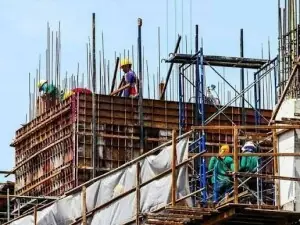
Housing and Construction The housing and construction sector remained neglected in past which created in housing backlog. In order to make up this backlog and meet the shortfall rapid housing production is needed. The major emphasis of the policy is on resource mobilisation, land availability incentives to home ownership, incentives to developers and constructors and promotion of research and development activities to make, construction cost effective. The objective is to create affordability, especially for the middle and low income groups.
According to the World Bank's recommended occupancy rates of 6 persons per house, the total number of required housing units in the country would be more than 25 million based on the population of 170 million at present. Realising the slump in the housing market, feeling the need to revive this important sector of economy and narrow the backlog functions of House Building Finance Corporation are rationalised and the corporation shall be restructured having clear goals and objectives.
The sector has enormous potential for poverty reduction and employment generation. The government has taken various steps to improve the environment for investment in this sector. These measures include; the improvement in the availability of housing finance by encouraging commercial banks to extend housing finance legal frame work for the loan recovery of financial institution streamlined, bank's exposure to housing finance has been enhanced. The maximum loan tenure for housing finance shall be increased from 20 years to 25 years. Banks and DFIs are extending credit facilities for Balancing, Modernisation and Replacement (BMR) of machinery used for housing and construction industry. HBFC has introduced bridge financing and bulk financing for housing projects through escrow accounting together with appropriate safeguard. House Building Finance Corporation (HBFC) and other financial institutions have, formulated packages of preferential/concessional rates with affordable system of instalments for repayment to provide affordable credit to low income groups.
House building loans from Housing Building Finance Corporation are generally utilised by borrowers from low income group. To give relief to this group, it is proposed that all cases shall be settled at original loan amount plus 5% rental for those whose time for repayment has expired. The outstanding frozen amount can be repaid over 36 equal monthly instalments through post dated checks. This will alleviate the hardship of borrowers which are mostly widows, retired persons anti people from extremely low incomes. It is further proposed that for the remaining outstanding cases, where the repayment time in not expired, borrowers will be allowed to repay the amount in equal instalment in remaining period of loan through post-dated cheeks. For such loans, the rental charge will be reduced to 5%. This concession will provide relief to another large, segment of borrowers of HBFC.
Government Private Sector Business Relationship Under MBC System (Mutual Benefit Coupon System) the government shall be having massive cash resources which would be available to banks for funding projects undertaken by private sector under special arrangements.
As mentioned earlier government shall disengage itself from import and supply of basic necessities and other business oriented activities and private sector shall be encouraged to invest in such businesses. Similarly the projects mentioned in the budget shall also be offered to private sector on BOT basis with specific terms and conditions. Adequate funds shall be provided by government through commercial banks to the private sector for completion of projects. The government shall participate in these projects on profit and loss sharing business. This budget also has the distinction of delivering economic sovereignty to our country as we are saying goodbye to the IMF. Undoubtedly; challenges remain on the horizon, yet we must acknowledge progress without being complacent. There is no exclusive on wisdom. While constructive criticism is always welcome, we must also recognise our strengths without which we will not be able to chart an effective strategy to face challenges.
NOORA KUSHTI
What is media doing? It has been hijacked by all and specially the famous anchor persons without any exception how? They never ask in their talk show to the leaders how you remove poverty or give at least one metal to 30% population. Why? Because there will be no answer and there will no more to talk and the talk show will be a flop as they could not fool the people any more this will result that anchor person will be fired because there was no fight. So to save his position he will never insist on these questions.
So i am not wrong to say that these anchor persons are the worst enemy of Pakistan as they have hijacked the media. Why they do not ask the clean man how will he bring justice and this question has never been asked to him. I am sorry to say that all these famous anchors very well know this system but are afraid to loose their jobs as there will not be any talk shows which they are conducting now. It is now time wake up and if you do not then "TUMHARI DASTAN TAK BHEE NA HOGI DASTANO MAIN"






















Comments
Comments are closed for this article.