


New Zealand PM claims vote mandate to sell assets

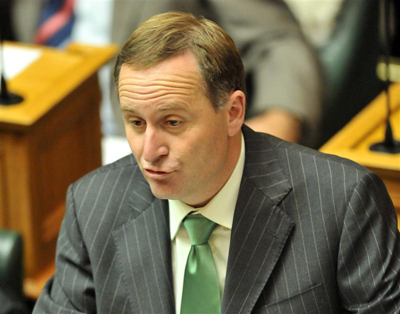 WELLINGTON: Prime Minister John Key on Sunday claimed the right to sell state assets to prop up a struggling economy after securing an overwhelming election victory to round off a turbulent year in New Zealand.
Key said the priorities for his centre-right administration were the partial sale of state-owned energy companies, welfare reform and rebuilding the earthquake-stricken city of Christchurch.
A partial sale of the government's shareholding in the national flag carrier Air New Zealand is also in the offing.
Saturday's general election was held at the end of a tumultuous year for New Zealand with the Christchurch devastation in February claiming 181 lives and an earlier coal mine explosion that killed 29.
Key, who won plaudits for the way he handled the crises, led his National Party to win 48 percent of the vote -- the best result by any party in New Zealand since 1951 and up from 45 percent in the last election in 2008.
Although the 60 seats it produced left him one short of an outright majority Key crossed the threshold with the continued support of previous coalition partners ACT and United Future which won a seat each.
The Maori Party, which also supported the last National-led administration, returns to parliament with three MPs and is likely to remain aligned with the government, further boosting Key's majority.
Key said he would meet ACT, United Future and Maori Party officials on Monday to discuss how they would support National in some policy areas and "agree to disagree" in others.
Although the planned asset sales were a contentious issue in the election, National's campaign manager Steven Joyce said the convincing election outcome showed there is a mandate to proceed.
"I think the reality is, with a 48 percent party vote, that's a pretty strong endorsement of where the government sits. We are confident we will be able to build the relationships needed to go ahead with the programme," he said.
Key said he would also have discussions with the Greens, the third-largest party which returned a party record 13 MPs to parliament, but he did not consider them relevant to his coalition.
"I remain of the view that it's likely to be a more policy-based agreement with the Greens rather than a formal confidence and supply agreement as we are likely to have with the other parties," he said.
The prime minister is faced with an economy growing just 1.5 percent in the year to June, and is committed to reining in a record NZ$18.4 billion ($13.6 billion) deficit which led to sovereign ratings downgrades in September.
Throughout the election campaign he heavily promoted asset sales as a way of retiring debt but opposition parties said that should be considered in isolation to the election outcome.
"People vote for a lot of different reasons," said Labour's campaign spokesman Grant Robertson, claiming "opposition to asset sales is still out there".
New Zealand First leader Winston Peters, who led his party from political oblivion in the last election to win eight seats this time, also said he believed the majority of people remained opposed to the sales.
Copyright AFP (Agence France-Presse), 2011



















Comments
Comments are closed for this article.