



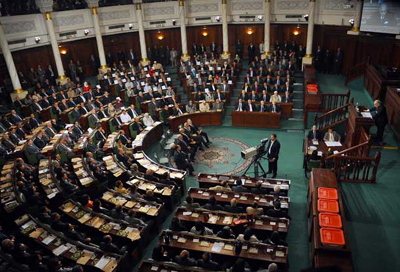
 TUNIS: Tunisia entered a new era of democracy Tuesday with the inaugural session of its democratically elected constituent assembly, 10 months after a popular uprising ended years of dictatorship.
The 217-member assembly, the first elected body produced by the Arab Spring, was expected to confirm a deal whereby the Islamist Ennahda party and two other parties split the country's top three jobs between themselves.
The lawmakers, who will be tasked with drafting a new constitution and paving the way to fresh elections, sang the national anthem as the session got under way in the Bardo palace on the outskirts of Tunis.
"I give thanks to God, to all those martyred and wounded and those who fought so we could witness this historic day," Ennahda leader Rached Ghannouchi told AFP after the opening.
After longtime dictator Zine el Abidine Ben Ali's ouster in January and internationally acclaimed polls on October 23, the inauguration marked yet another landmark in the Arab Spring trailblazers' democratic revolution.
"This event is like a second independence for Tunisia," said Ahmed Mestiri, an iconic figure in the struggle for Tunisia's 1956 independence from France.
Several hundred demonstrators, including relatives of some of the protesters killed in the uprising, nevertheless greeted the newly-elected lawmakers at the Bardo palace with a warning.
"We're watching you," read some of the banners.
"We're here to remind the lawmakers of the demands of the Tunisian revolution -- dignity and freedom -- and to tell them the Tunisian people have not handed them a blank cheque," said Rafik Boudjaria of the Civic Front for Democracy and Tunisia.
Despite Ennahda's assurances, some Tunisians have expressed concern that an Islamist-dominated Tunisia could roll back hard-earned rights such as the Code of Personal Status, seen notably as one of the Arab world's most progressive sets of laws on women.
"Tunisia wants to hold up a model to society in which Islam is not a synonym of terrorism, fanaticism, extremism or hostility to democracy," Ghannouchi said Sunday during a visit to Algiers.
Speaking to AFP Tuesday, Ghannouchi -- who does not sit in the assembly and insists he does not seek any official post in the new executive -- promised to promote "a national reconciliation project... not a revenge project".
On Monday, Tunisia's three main political parties formalised a power-sharing agreement hammered out in the aftermath of last month's polls.
Ennahda's Hamadi Jebali is to take the post of prime minister, the Congress for the Republic (CPR) party's Moncef Marzouki will become president and Ettakatol's Mustapha Ben Jaafar the chair of the new assembly.
A popular uprising that started in December 2010 over unemployment and the soaring cost of living ousted Ben Ali, who had been in power 23 years and was thought to be one of the world's most entrenched autocrats.
The revolt touched off a wave of pro-democracy protests across the region and Tunisians anchored their revolution last month with a historic election for a constituent assembly.
Ennahda, a moderate Islamist party inspired by the Muslim Brotherhood, holds 89 seats while the CPR and Ettakatol control 29 and 20 seats respectively.
The chamber's freshly-elected members are also expected to pick two deputy chairs and adopt a set of internal rules based on a document drafted by the now-dissolved body in charge of political reform after Ben Ali's ouster.
Challenging the bloc formed by the three main parties, the Progressive Democratic Party and the Democratic Modernist Pole, which have 16 and five seats respectively, will be main opposition forces.
A question mark still hangs however over the Popular Petition, a previously unknown group lead by a London-based millionaire which came out of the woodwork to clinch 26 seats, making it the assembly's third largest party.



















Comments
Comments are closed for this article.