



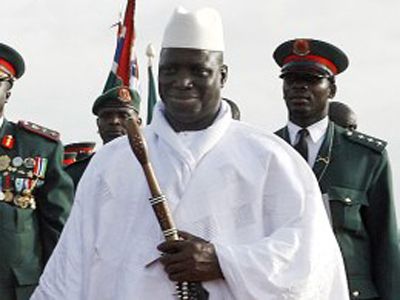
 BANJUL: Gambia, which holds a presidential election on Thursday, has been led by Yahya Jammeh since he took power in a 1994 coup.
Rights bodies accuse him of having created a climate of fear and of having quashed any dissent against his regime.
- GEOGRAPHY: Gambia is a narrow strip of land running in from the Atlantic coast, surrounded on the other three sides by Senegal. Its surface area is just 11,300 square kilometres (4,520 square miles).
- POPULATION: 1.75 million (World Bank, 2010). Main ethnic groups include Mandinka, Fula and Wolof.
- CAPITAL: Banjul.
- LANGUAGE: English is the official language. Mandinka, Fula and Wolof are also widely spoken.
- RELIGION: Muslim (85 percent), Christian and animist (15 percent).
- HISTORY: A former British dependency, Gambia became a British colony in 1888. It gained independence within the Commonwealth in 1965 when Dawda Jawara became prime minister at the head of the People's Progressive Party (PPP).
The country became a republic on April 24, 1970 when Jawara was appointed president. He remained in power until he was overthrown in a bloodless military coup led by the young lieutenant Jammeh on July 22, 1994.
A new constitution was adopted in 1996, followed by presidential elections won by Jammeh, signalling a return to a civilian regime. Jammeh again won elections in 2001 and 2006.
His party, the Alliance for Patriotic Reorientation and Construction (APRC), holds a large majority in the 45-member National Assembly after 2007 legislative elections.
A 2002 constitutional amendment provided for unlimited presidential mandates.
- ECONOMY AND RESOURCES: Agriculture is Gambia's number one resource, with peanuts, millet, maize and manioc. Also fishing and tourism.
In 2008 Jammeh said that uranium had been found in exploitable quantities in the country, along with gold, titanium, silicon and iron.
Despite progress in establishing infrastructure including roads, telecommunications and schools, Gambia's economy and social structure remain weak.
- GNP: 461 dollars per capita (World Bank, 2010).
- DEBT: 520 million dollars (World Bank, 2009).
DEFENCE: 800 armed forces (International Institute of Strategic Studies, 2010).



















Comments
Comments are closed for this article.