


Asia defence immune from budget cuts : Obama

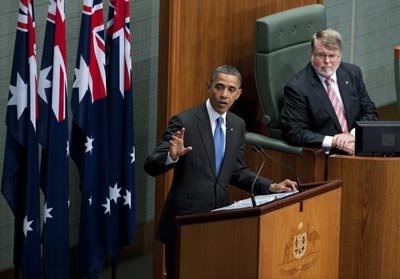 CANBERRA: US President Barack Obama Thursday pledged he would not allow a budget crunch in Washington to compromise a modernised defence posture designed to cement America's destiny as a top Pacific power.
In a message aimed both at a dynamic region he sees as key to the US economic future and warring lawmakers at home, Obama told the Australian parliament the Asia-Pacific was too vital to fall prey to US penny pinching.
"Let me address this directly. As the United States puts our fiscal house in order, we are reducing our spending," Obama said, warning reductions in funding for the US military machine were inevitable after years of war spending.
But he added: "Here is what this region must know. As we end today's wars, I have directed my national security team to make our presence and missions in the Asia Pacific a top priority.
"As a result, reductions in US defence spending will not -- I repeat, will not -- come at the expense of the Asia Pacific."
"The United States is a Pacific power, and we are here to stay."
Seeking to pivot away from a decade of bloodshed and pain in the Middle East, the Obama White House is seeking to adjust and enhance the US defence posture in Asia.
It will send 2,500 US Marines to Australia and will tighten cooperation between the two nation's air forces, and is committed to keeping a strong naval presence as well as garrisons in South Korea and Japan.
Obama's comments on funding represent a landmark moment in US policy towards a region seething with territorial disputes, containing trade routes vital to US prosperity and which is transfixed by the rise of China.
Few other areas of US spending, domestic or overseas, will benefit from such a firewall. For instance, some key social programmes beloved of Obama's Democrats face years of cuts and falling funding.
The president spoke as a congressional super-committee struggles to come up with $1.2 trillion in deficit cuts by November 23.
If the panel founders amid a hyper-partisan standoff between Democrats and Republicans, deep spending cuts will be unleashed which will include a $500 billion blow to defence spending.
Defense Secretary Leon Panetta has warned that such slashing cuts, on top of $450 billion already demanded of the Pentagon, could imperil US national security and constrain US operations overseas.
Obama gave his commitment on the latest leg of a Pacific tour, taking place with one eye on China's rising influence, which is meant to underscore that the United States will remain a key player in Asia-Pacific security.
"We will preserve our unique ability to project power and deter threats to peace," Obama said.
"We will keep our commitments, including our treaty obligations to allies like Australia.
"And we will constantly strengthen our capabilities to meet the needs of the 21st century. Our enduring interests in the region demand our enduring presence in this region."
Obama believes that the booming Pacific rim, worth trillions in dollars in trade to the United States, is vital to America's economic future, and will produce jobs and prosperity for decades to come.
In his speech, Obama also surveyed US policy towards Asia, which has evolved in three years, and three trips to the region that he has taken as president.
"Here, we see the future. As the world's fastest-growing region -- and home to more than half the global economy -- Asia is critical to achieving my highest priority: creating jobs and opportunity for the American people," he said.
Obama is facing a tough reelection fight next year amid 9.0 percent unemployment and a slow recovery, and is under huge political pressure to demonstrate he can leverage jobs and economic growth from Asia.
The president said bluntly on Wednesday that the United States did not "fear" China, nor was it trying to keep the emerging giant from joining organisations such as the nascent Trans Pacific Partnership on trade.
But he doubled down on his warnings that as a emerging power, China would have to live up to "rules of the road " on international relations and trade, and contribute to a future where fair competition boosted all nations.
Copyright AFP (Agence France-Presse), 2011


















Comments
Comments are closed for this article.