



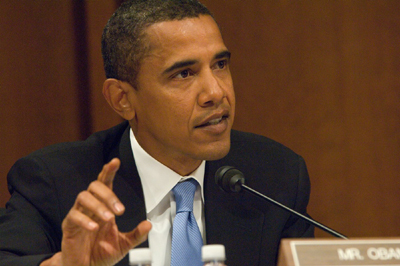
 WASHINGTON: US President Barack Obama's swing through the Pacific starting Friday is already a tough sell to a Washington political class fixated on the next big political flap and the quickening 2012 campaign.
White House officials are being forced to defend Obama's nine-day odyssey to tropical paradises Hawaii and Bali, plus Australia, which includes two major summits and a flurry of talks with the world's most powerful leaders.
The notion that a US president would have solid diplomatic reasons for engaging in a region likely to frame America's future is hardly far fetched.
But with Obama weakened by high unemployment and a moribund recovery, aides are billing the trip as an extension of his domestic agenda, especially when he hosts the Asia Pacific Economic Cooperation forum summit in Hawaii Sunday.
"The president's number-one priority is job creation, and our efforts to create American jobs are tied very directly to our engagement in the Asia-Pacific," said deputy national security advisor Ben Rhodes.
"Our trade with APEC nations supports millions of American jobs."
Rhodes argued that Americans wanted to see their president overseas as an effective advocate for US interests on the world stage.
Danny Russel, senior director for Asia on the National Security Council, painted Obama's trip as taking care of America's own backyard.
"This isn't a trip to the far-flung corners of Asia," he said.
"This is a trip to the Asia-Pacific. The US is very much an Asia-Pacific nation. We're a resident power," he said.
As well as the APEC summit, Obama will meet the leaders of Russia, China, Japan and India on his travels, mark 60 years of defense cooperation with Australia and attend the East Asia summit in Bali.
Questions at a White House briefing on Wednesday revealed skepticism about the trip as a new political crisis brews.
One reporter asked whether Obama was going to "really make news" or was simply set to emphasize economic and military ties.
A congressional supercommittee composed of Republicans and Democrats is coming up hard against a deadline to find 1.2 trillion dollars in deficit cuts -- and some observers feel the president should be around to throw his weight.
Obama, battling to save his job in next year's election, will also be abroad just as his campaign to skewer Republicans for blocking his jobs plan seems to be gaining traction.
Hawaii-born Obama, billing himself as America's first Pacific President, has made developing, dynamic, Asia a priority, arguing that it is the key to America's future economic prosperity.
But such a message, which also underpinned Obama's trip to India last year, will be difficult to sustain through a week and two foreign summits.
"How the White House manages the press narrative on this is really tricky. And I'm not sure how they do it," said Michael Green, a former senior staffer for Asia in George W. Bush's White House.
Douglas Paal, of the Carnegie Endowment for International Peace, said the "soft" agenda of the East Asia summit could also complicate matters.
"I can see ... the domestic political advisers saying, '10 days in the Pacific while people are out of work in the US? 'Mr. President, you ought to cut this one short.'
"They tell me they're not going to cut it short ... but I wouldn't be surprised if it happened."
Obama has already cancelled trips to key ally Australia twice over domestic political crises.
He will also be the first American president to take part in the East Asia summit, which officials see as vital to US political and security goals.
To pass on the event would be sure to raise doubts about long-term US commitment to Asia, which Obama and Secretary of State Hillary Clinton have been working hard to dispel.
This will not be the first time Obama has had trouble selling his trips to Asia to a skeptical press corps.
One problem may be that diplomacy, as practiced in Asia, often elaborately formal, is alien to those who inhabit Washington's rowdy political swamp.
Communiques clogged with diplo speak often make it tough for the uninitiated to parse a president's performance in Asia.
And the US project of balancing the economic and strategic rise of China will take years, several administrations and is outrun by 24-hour news cycles.






















Comments
Comments are closed for this article.