



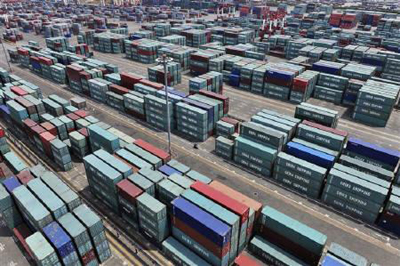
 BEIJING: The value of China's exports and imports fell in October from the previous month, official data showed Thursday, as domestic tightening measures and turbulence in Europe and the United States hit demand.
The data is likely to fuel concerns over the country's manufacturing sector, which employs hundreds of millions of people and is a key driver of the world's number two economy, while boosting the chances of an easing in credit controls.
It comes a day after International Monetary Fund chief Christine Lagarde warned the world risked plunging into a "downward spiral" of financial instability while Asia would not be immune to the crisis sweeping the eurozone.
China's exports rose 15.9 percent year on year to $157.49 billion in October, down from $169.7 billion in September, the customs agency said in a statement.
Shipments to the European Union -- China's biggest trade partner -- fell to $28.74 billion in October from $31.61 billion in September.
Exports to the United States shrank to $28.60 billion in October from $30.11 billion in the previous month.
Imports expanded 28.7 percent to $140.46 billion in October, lower than the $155.2 billion recorded a month earlier.
China's politically sensitive trade surplus -- a constant bugbear for major trade partners such as the United States and Europe -- widened to $17 billion in October from $14.51 billion in September.
IHS Global Insight analyst Alistair Thornton said the downturn in China's key export markets would act as a "a brake on growth and potentially forcing the authorities' hand in rolling out monetary easing".
"The EU is China's largest trade partner and intricately coupled with the global financial system, so it stands to reason that European weakness means headwinds for China," said Thornton.
Shanghai shares fell 1.05 percent in morning trade, tracking falls across the region.
Beijing, anxious about surging inflation, has been pulling on a variety of levers to curb consumer and property prices in the past year, including restricting the amount of money banks can lend and hiking interest rates.
The measures appear to be taking effect -- inflation slowed sharply in October from the previous month, property sales have declined nationwide and output from the country's millions of factories and workshops has slowed.
But Beijing has indicated it may fine-tune policy as the deepening eurozone crisis and US economic woes squeeze demand for Chinese exports and small businesses struggle to get financing, putting at risk millions of jobs.
Bank of America-Merrill Lynch economist Lu Ting warned there was a growing risk of a break-up of the eurozone, which could trigger a sudden collapse in the global financial system.
"If that happens, China's export growth could slump," Lu said.
Premier Wen Jiabao repeated last month that controlling prices was a key task, but also said the government could alter economic policy when the time was right, fuelling expectations for an easing in credit restrictions.
Analysts said policymakers were likely to reduce the reserve requirement ratio -- the portion of deposits banks must set aside -- in the coming months to spur lending, but they ruled out a change in interest rates.





















Comments
Comments are closed for this article.