



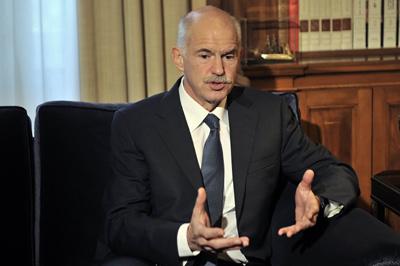
 ATHENS: Prime Minister George Papandreou Saturday scrambled to form a national crisis government to implement a crucial eurozone rescue package, fresh from winning a nail-biting confidence vote.
After an hour-long meeting with President Carolos Papoulias, Papandreou emerged to tell a scrum of reporters that contacts would begin "very soon" with other parties to forge a government of "broad consensus".
"I came today to discuss my intention to contribute in a decisive fashion to a government of broad consensus," he said.
The aim of this unity government would be to push through the EU bailout plan agreed last week in Brussels designed to keep the debt-wracked country afloat, he added.
"The application of this deal is the precondition for us staying in the euro. It's as important as that," he said.
However, it remained unclear whether he would be able to secure the support of the opposition conservatives, whose leader Antonis Samaras steadfastly stuck to his demand for early elections, which Papandreou said would be catastrophic.
Ahead of the talks, Papandreou had told Papoulias that the lack of consensus in Greek politics risked raising "doubts amongst our European partners about our desire to stay in the eurozone."
Under intense pressure from European partners and facing a rebellion within his own socialist ranks, Papandreou indicated in a half-hour address to MPs in the early hours of Saturday that he would step aside.
"I am not interested in a chair, the last thing I am interested in is whether I am re-elected," said Papandreou, who swept to a landslide national election victory in 2009.
But Samaras defiantly held out for snap elections, raising the spectre of renewed political deadlock in the country, which could delay the payment of much-needed aid and intensify the eurozone debt crisis.
"The mask has fallen. Papandreou has rejected our proposals and he must take responsibility for that," said Samaras, who heads the opposition New Democracy party.
"Elections are now the only answer."
The parliamentary head of Papandreou's socialist Pasok party, Christos Protopapas, warned that the talks could still end in failure.
"I would like to believe that there is still room for manoeuvre, but the crisis is getting worse," Protopapas told Net public television.
"What the Greeks want -- a team led by a third person, neither Papandreou or Samaras -- is in the process of being lost. It's dangerous," he said.
Earlier Saturday, Papandreou had pulled off a stunning political victory by winning a cliffhanger of a confidence vote by just eight votes amid high tension.
The result had hung in the balance amid unbearable tension as each MP voted in favour or against the motion, with the "yes" and "no" camp neck-and-neck right to the end.
Adding to the pressure, several thousand communists staged noisy protests in front of the floodlit building as the debate took place.
There was bewilderment on the streets of Athens and renewed calls for the politicians to sort out Greece's worst economic crisis in decades.
"The people are suffering at the moment and they (politicians) are not budging," said Marianna, a shopkeeper.
"A unity government with whom? With the same people? We will have the same results," she said gloomily.
Another Athenian, a businessman who gave his name as Mosafari, said: "These problems should have been solved 30 years ago."
And there was no signs of a let-up in the fierce pressure being exerted by Greece's European partners.
German Chancellor Angela Merkel warned in her weekly webcast that Europe would need a decade to clean up its finances and emerge from the current debt crisis.
"Everyone in Europe must make an effort to achieve all that is required," Merkel said.
As the politicians squabbled, Greece is fast running out of cash.
Finance Minister Evangelos Venizelos announced recently that Greece "absolutely needed" by December 15 an eight-billion-euro ($11-billion) slice of aid from a 2010 EU rescue package.
Venizelos told MPs earlier Saturday that Greece needed a representative to attend a meeting of eurozone finance ministers in Brussels on Monday where talks on the next tranche of bailout cash would take place.
"Playing politics with fire," the Kathimerini daily wrote on its front page.
The vote capped a tumultuous week for Greece that began with Papandreou's disastrous call for a referendum on the 100-billion-euro ($138-billion) EU bailout package that sparked revolt in his own party and roiled markets.
Analysts had warned that renewed political uncertainty could halt the disbursement of a fresh eight-billion-euro loan package that Greece needs to pay the bills.
Following some rigorous discussions with the German and French leaders Papandreou swiftly scrapped the referendum idea before the confidence vote.
Venizelos, tipped in the media to become interim prime minister, said that elections could be held once negotiations on the EU bailout package are complete.
He said the new government would be in power "until the end of February" when details on the plan are expected to be completed "so they can be submitted to the electoral inspection of the Greek people."
Copyright AFP (Agence France-Presse), 2011





















Comments
Comments are closed for this article.