



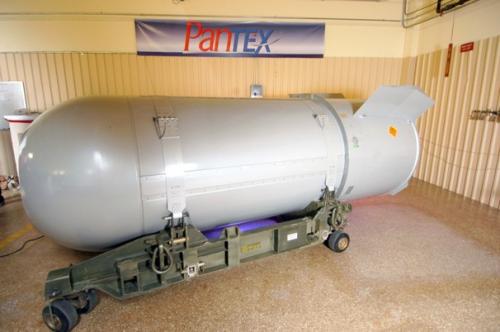
 WASHINGTON: Technicians in Texas closed a chapter on the Cold War on Tuesday, dismantling the oldest, biggest and most powerful nuclear bomb in the US arsenal, officials said.
The last B-53 bomb -- built in 1962, the year of the Cuban missile crisis -- was dismantled at the Pantex facility in Amarillo, the only place in the United States that still builds, maintains and dismantles nuclear weapons.
Grey in color, weighing 10,000 pounds (4,500 kilograms) and as big as a small car, it had the power to wipe out an entire metropolitan area with its nine-megaton yield when dropped from a B-52 bomber.
By comparison, the atomic bomb that destroyed the Japanese city of Hiroshima in the final days of World War II packed a yield of 12 kilotons, or 0.012 megatons. The bomb killed more than 100,000 people.
"It's significant in the sense that it's the last of these multi-megaton weapons that the nuclear powers used to build during the height of the Cold War," said Hans Kirstensen of the Federation of American Scientists.
"This is the end of the era of these monster weapons," he told AFP.
Dismantling the B-53 bomb -- retired from service in 1997 -- involved separating 300 pounds of high explosive from the uranium "pit" at the heart of the weapon, Pantex spokesman Greg Cunningham told AFP.
"The world is a safer place with this dismantlement," Thomas D'Agostino, director of the National Nuclear Security Administration, said in a Pantex statement.
"The B-53 was a weapon developed in another time for a different world" and its "elimination" marks a major step in President Barack Obama's efforts to scale back the role of nuclear weapons in US security policy, he said.
Last May, the United States revealed for the first time the actual size of its nuclear stockpile -- a total of 5,113 warheads as of September 30, 2009, the Pentagon announced.
That figure -- a 75 percent reduction from 1989 when the Berlin Wall fell -- included active warheads ready for deployment at short notice, as well as "inactive" warheads maintained at a depot in a "non-operational status."
Under a new strategic arms limitation treaty (START) treaty, agreed in April last year, the United States and Russia -- which hold nearly all nuclear weapons -- pledged to reduce their arsenals to 1,550 warheads each.
The B-53 bomb was so big that a B-52 bomber could only carry two of them. Each was fitted with parachutes to control their descent, according to videos made public by the National Nuclear Safety Administration.
"This particular weapon should have been phased out and dismantled a long time ago," said Kirstensten, director of the nuclear information project at the Federation of American Scientists in Washington.
"But it was allowed to linger in the stockpile because it had an important mission -- knocking out underground targets" by cratering the surface with its awesome force, he said.
The most powerful US warheads today yield around 1.2 megatons, fitted onto guided missiles.
The total number of B-53 bombs ever manufactured is still classified information, Cunningham said, but the nuclearweaponarchive.org website put the figure at 350, with 50 stockpiled in 1997.
It was replaced by the B-61 bomb, a mid-1960s design with a variable yield of up to 340 kilotons, the website said.






















Comments
Comments are closed for this article.