



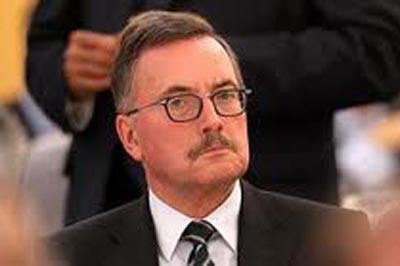
 FRANKFURT: Below is a profile of Juergen Stark, who sources in Berlin and Frankfurt said on Friday was set to quit his position on the European Central Bank's Executive Board, born May 31, 1948 in Gau-Odernheim in Germany Current age 63.
A former finance ministry official and Bundesbank vice-president, Stark, known for his tough, no-frills style, has been a member of the ECB executive board since June 2006. His eight year term was due to run until May 31 2014.
Stark holds a doctorate in economics from 1975 after studies at University of Hohenheim and of Tuebingen in Germany.
Stark's name means 'strong' in German.
One newspaper reported he would introduce himself as "Stark, as in the Deutsche Mark".
He joined the German economics ministry in 1978, worked for the German Chancellor's office 1988-1992 and then moved to the Finance Ministry.
Appointed state secretary in 1995, he accompanied then-Finance Minister Theo Waigel on a helicopter ride to the Bundesbank headquarters to urge central bankers to revalue gold reserves to help Bonn meet budget deficit targets. The plan failed. Then he became a vocal opponent of gold sales.
As deputy finance minister from 1995 to 1998 under the Christian Democrats, he played a key role in negotiating the Stability and Growth Pact, the budgetary rules that underpin the euro.
Stark, who once said there was no room in the euro zone for "Keynesian romanticism" recently gave the following quote, neatly summing up his stance: "The ECB's monetary policy will be diligently and without a compromise directed to price stability."
On Europe's debt crisis, Stark has said indebted countries should not expect any direct help from the ECB and must cut their deficits fast. Stark has always been considered one of the most 'hawkish' ECB members and takes a strict line on inflation. While maintaining his clear views he has been less outspoken and more guarded over the last year.
He was, however, reported to have led a quartet of ECB members who opposed the ECB's decision last month to reactivate its controversial bond purchase programme.
Stark, a Rhinelander, had long been tipped as Axel Weber's successor at the helm of the Bundesbank until Weber's sudden resignation early this year derailed the plans and saw Jens Weidmann rushed into the role instead.
Copyright Reuters, 2011
















Comments
Comments are closed for this article.