


Russia delays space mission after crash

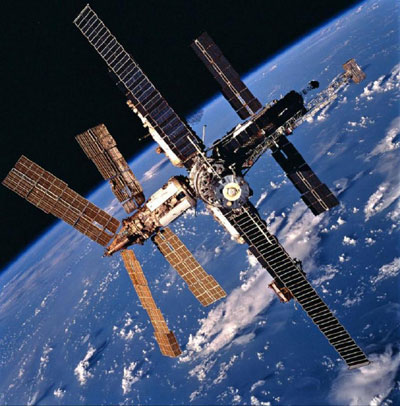 MOSCOW: Russia postponed the next manned mission to the International Space Station by at least a month on Monday and an official said any further delay might force Moscow to consider leaving the station unmanned for the first time in a decade.
The Russian space agency, Roskosmos, announced its decision to allow time for safety checks to be made following the crash of an unmanned cargo craft ferrying food and fuel to the space station on Aug. 24.
It set no new dates for the missions in a brief statement.
But Russian news agencies said three of six crews would now return to Earth around Sept. 16, instead of Sept. 8, and the replacements would blast off in late October or early November instead of on Sept. 22.s
"If for any reason we will not be able to deliver the crew before the end of November, we will need to review all possibilities including leaving the station unmanned," Alexei Krasnov, who is in charge of manned flights at Roskosmos, was quoted as saying by Interfax news agency.
Interfax quoted an unnamed space official as saying Roskosmos would carry out two test launches of its unmanned Soyuz rocket before sending the next astronauts into space.
The International Space Station, an orbiting research laboratory which is a $100-billion project involving six countries, has been permanently manned for more than a decade.
The next launch of crew members to the space station will be the first since the US space agency NASA retired its 30-year shuttle programme in July.
This has caused concern at NASA as it now relies entirely on Russian craft to send people into space.
Russian space officials hope the announcement of safety checks will increase confidence following the crash, in which a Russian Soyuz-U craft failed to reach orbit and burned up in the atmosphere shortly after launch.
The Soyuz-U, whose failure was caused by an apparent problem with the rocket's upper-stage motor, closely resembles the Soyuz-FG used to transport astronauts to the orbital station.
"These delays and checks are normal following such a failure. I think they will manage to get a craft to the space station to avoid it being unmanned," said Igor Lissov, editor of monthly Russian space journal Novosti Kosmonavtiki.
"You can run the space station from Earth but you can't do it as well as when it is manned," he added, but declined to speculate how long it could be left unmanned.
NASA said last week the six astronauts in orbit had enough food and water to go several months without supplies. But bringing astronauts back to Earth would be safer before winter starts in Kazakhstan, where they would touch down.
The station is manned by US astronauts Ron Garan and Mike Fossum, Japan's Satoshi Furukawa and Russian cosmonauts Sergei Volkov, Alexander Samokutyayev and mission commander Andrey Borisenko.
Borisenko, Samokutyayev and Garan are due to end their mission.
Last week's failure was an embarrassment for Russia's space industry after a series of costly botched launches. Media reports put the cumulative recent losses at more than $553 million.
Prime Minister Vladimir Putin has ordered an overhaul of safety checks on Russia's rockets while a pro-Kremlin lawmaker said the lower house would review whether "systemic problems or just bad luck" were to blame for the failures.
Copyright Reuters, 2011




















Comments
Comments are closed for this article.