



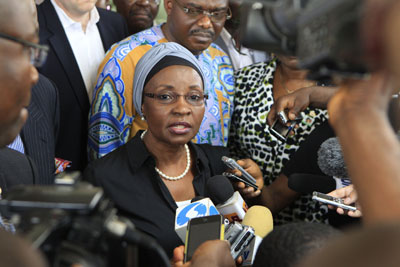
 ABUJA: The UN's deputy chief met Nigeria's president Sunday after vowing a renewed fight against terrorism in the wake of a suicide bomb attack at the world body's headquarters here that killed at least 21.
Deputy UN Secretary General Asha-Rose Migiro laid wreaths at the UN compound in Africa's most populous nation and made her way past crushed debris and what looked to be blood stains during a tour of the badly damaged building.
"It is a shocking incident," she said afterward. "This attack is against global peace. It is also against humanity because those who work here come from different countries."
She later visited victims at the national hospital and held talks with President Goodluck Jonathan.
Jonathan said that the UN would be provided temporary accommodation to allow work to continue and Nigeria would help with reconstruction of its headquarters.
Friday's attack that saw the bomber make his way through two gates at the heavily guarded compound before slamming his car into the entrance of the building was among the bloodiest targeting the UN globally.
Migiro said earlier that "this act of terrorism will only rekindle our resolve to fight terrorism".
The UN's security chief was also in Nigeria and said there was no specific threat to the headquarters in Abuja before it was attacked.
"There was general information on the threat of attack (globally) about a month ago," Gregory Starr, UN Under Secretary General for Safety and Security, told journalists.
"There was nothing specific. But the UN security agency alerted the various governments about this threat, and because there was no timing, there was no indication of where and when this attack would be carried out, this is the most I can say."
The UN officials' trip came as the investigation into the bombing in Abuja deepened, with FBI agents from the United States also in the country.
Migiro announced that at least 21 people had been killed and 73 injured, 26 of whom were in intensive care. A UN spokesman had earlier said 23 were killed and Migiro did not explain why the number had changed.
Some 400 people with a variety of nationalities worked in the UN building. A breakdown of the nationalities of the victims was yet to be released.
Questions swirled over how the bomber managed to pass through two gates in the exit lane of the compound as well as over who was responsible for the blast in the continent's largest oil producer.
A purported spokesman for the Nigerian Islamist sect known as Boko Haram has claimed responsibility for the attack, but there has been no proof and police say they are considering all possibilities.
Analysts have cautioned that while at least one faction of the sect may indeed be involved, it was too early to draw any firm conclusions.
Boko Haram has previously focused on targeting symbols of Nigerian authority, but its attacks have grown increasingly sophisticated and concerns have grown over whether it has formed links with Al-Qaeda's north African branch or other extremist groups.
"Such attacks will neither deter us in our work nor win any new sympathisers to whatever cause might be the motivation," Migiro said.
"There can be no justification for terrorism. The perpetrators must be brought to justice."
A bomb blast that rocked a car park at national police headquarters in Abuja in June and killed at least two people was claimed by Boko Haram. Police first said it was the result of a suicide blast before later retracting their statement, saying they could not be sure.
Most of the attacks blamed on the sect have occurred in the country's northeast, but a number have been carried out elsewhere, including the previous explosion in Abuja as well as several in Suleija near the capital.
The Islamist sect launched an uprising in 2009, put down by a brutal military assault that left hundreds dead.
It went dormant for about a year before re-emerging in 2010 with a series of assassinations of security personnel and politicians, as well as religious and community leaders.
Nigeria's 150 million population is roughly divided in half between a mainly Muslim north and predominately Christian south.
Copyright AFP (Agence France-Presse), 2011













Comments
Comments are closed for this article.