



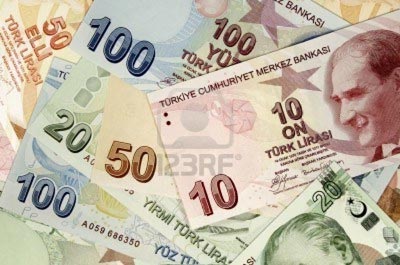
 ISTANBUL: Turkey's lira held steady on Tuesday despite data showing the trade deficit - the main weakness of its economy - widened more than expected last month.
The deficit increases Turkey's vulnerability to shifts in global liquidity. Tuesday's data showed it widened last month to $8.04 billion from $7.08 billion a year earlier, above a Reuters forecast of $6.75 billion.
"There were a few one-off numbers that made this (deficit) number a bit less reliable than normal - for example the calendar effects for the timing of a national holiday. The central bank told economists on Friday they expected weak exports in August but that they would pick up in September," said Manik Narain, head of EMEA strategy at UBS.
"At this stage it is a little bit difficult to read from."
The lira was at 2.2765 against the dollar at 0907 GMT, little changed from 2.2750 early in the morning. It remained firmer than the almost eight-month lows seen on Monday.
Turkey's large current account deficit is driven by energy imports and financed by foreign capital inflows. Investors in emerging markets such as Turkey have become increasingly nervous about a possible rise in U.S. interest rates, which would make riskier, higher-yielding assets less attractive.
The Turkish Statistics Institute data showed imports rose 7 percent in August, while exports rose only 2.9 percent.
Exports to Iraq, still Turkey's second largest export market year-to-date despite increased violence and political instability, continued to suffer as Islamic State militants made further advances. The total value of Turkish exports to Iraq stood at $647 million in August, down from $871 million a year earlier but up from $588 million seen in July.
ENERGY PRICE HIKES
Also on Tuesday, Turkish Energy Minister Taner Yildiz announced a 9 percent increase in gas and electricity prices for consumers starting from October, raising the pressure on inflation and the country's central bank.
The bank has struggled to contain consumer price rises - inflation reached 9.54 percent in August, double the bank's 5 percent year-end target rate - while having at the same time to contend with government pressure to cut interest rates and protect economic growth ahead of 2015 parliamentary elections.
"This is a setback for the central bank and raises the likelihood of an upward revision in inflation levels next month. So far it has been resorting to interbank tightening through the daily repos but they have made it clear they don't see the need for more permanent rate hikes," Narain said.
"This can be an issue for every asset class as the central bank shuns more permanent tightening."
The 10-year benchmark bond yield eased to 10.02 percent compared with 10.1 percent on Monday.
On Tuesday the Turkish treasury will tap benchmark two-year and 10-year fixed coupon bonds.
Istanbul's main share index rose 0.16 percent to 74,768.72 points on Tuesday, outperforming broader emerging markets which were down 0.18 percent.


























Comments
Comments are closed for this article.