



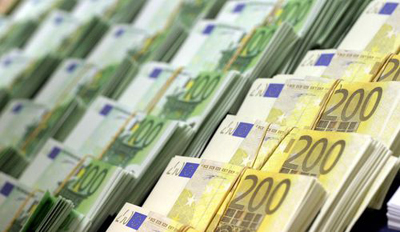
 LONDON: The euro edged off its lowest point in almost a year on Wednesday as Germany's finance minister played down speculation over more European Central Bank monetary policy easing in the coming months.
The shared currency was trading at $1.3183, up 0.1 percent on the day, after falling as low as $1.3151 in Asian trade.
Germany's Finance Minister Wolfgang Schaeuble was quoted in a newspaper on Wednesday as saying ECB chief Mario Draghi had been "over-interpreted" after he said he would use "all the available instruments" should inflation weaken more.
Some had seen Draghi's comments, made at the US Federal Reserve's annual conference at Jackson Hole over the weekend, as a sign that the ECB was considering the introduction of quantitative easing in the euro zone.
"Our contention is that Draghi and the ECB are turning more dovish, but nowhere near as dovish as the market has interpreted it post-Jackson Hole," said Adam Myers, head of foreign exchange strategy at Credit Agricole in London. "And because of that, today we think the euro will bounce - it's gone too far."
The euro was resilient despite data showing German consumer morale fell for the first time in more than 1-1/2 years heading into September as shoppers grew more wary of the impact of sanctions on Russia and other international conflicts.
It also brushed off Italy's economy minister quoted in the Corriere della Sera paper as saying the country must cut its growth forecast.
That could bring the government into line with most economists, who expect little or no growth for the euro zone's third-largest economy this year.
All eyes are now on euro zone inflation numbers on Friday and the ECB's next policy meeting on Sept. 4.
Despite its bounce against the dollar, the euro struggled against a slew of currencies, including the British pound. Earlier on Wednesday, the euro touched its lowest level in nearly 10 months versus the Australian dollar at A$1.4109 .
Against the Canadian dollar, the euro set a nine-month low of C$1.4362.
KIWI RISES
The New Zealand dollar was the biggest mover among developed currencies, rising just over 0.5 percent to $0.8377, edging away from a six-month low of $0.8311 hit on Tuesday.
The kiwi found support after giant cooperative Fonterra reaffirmed its forecast for its farm gate milk price for the 2014/15 season and announced a partnership with a Chinese food manufacturer to sell milk in China.
Dairy is New Zealand's largest export earner.
The dollar index, which measures the greenback against a basket of major currencies, edged back slightly after having hit a 13-month peak of 82.727 in Asian trade.
Data on Tuesday showed orders for US-manufactured durable goods posted their biggest gain on record in July, while consumer confidence rose in August to its highest level since October 2007.
But some traders said that US data would need to be even stronger before the Fed's rate-setting Federal Open Market Committee would consider tightening policy.
"The US figures will have to be more convincing to provide further strong impetus for the hawks on the FOMC and thus the dollar," said analysts from Commerzbank in a morning note.
"However, given the increased probability of further expansionary measures from the ECB and thus an ever widening divergence between monetary policies, euro/dollar is likely to continue to be pulled in a southerly direction."
























Comments
Comments are closed for this article.