


Govt to hike water down tax ‘Japan’

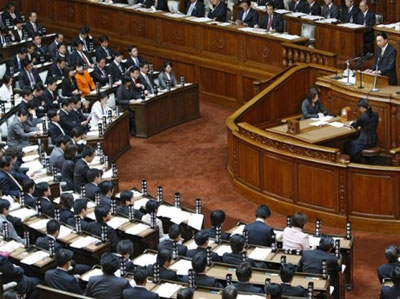 TOKYO: Lawmakers in Japan's ruling Democratic Party agreed on Wednesday to push the government to water down a planned sales tax due to worries about the economy, even as inaction raises the risk of a sovereign rating downgrade.
The agreement effectively undermines the government's commitment to double the sales tax to 10 percent by the 2015 fiscal year to fund rising social security costs and try to reduce the country's large public debt.
The government, rating agencies, the International Monetary Fund and many economists argue that higher taxes are necessary to prevent rising social security costs from blowing an even greater hole in Japan's finances. The country is already saddled with debt twice the size of the economy.
"We've reached the point where we have to cross the first hurdle," Koichiro Gemba, policy chief for the Democratic Party, told lawmakers meeting on tax and social security reform.
"I will try to get as much leeway on the tax hike timing as possible."
Because of resistance within its own power base, the government has already missed a self-imposed June 20 deadline to agree on the tax increases, so additional delays or a weakened plan would damage its credibility further.
BAD OMEN
Moody's Investors Service has already warned that missing last week's deadline was a bad omen for Japan's debt rating, yet another headache for Prime Minister Naoto Kan, Japan's fifth premier in as many years.
Kan faces rebels in his party and a hostile opposition that is using its control of parliament's upper house to block legislation, hoping to force him to resign.
"The chance of a downgrade is increasing, and it seems the government is losing its ability to chart a course that repairs public finances," said Takahide Kiuchi, chief economist for Japan at Nomura Securities.
"Even if the government is able to reach a deal, it's unlikely that the opposition would go along and pass the legislation."
Economists also warn that even in its original form, the plan was not ambitious enough, with changes to social security actually leading to a rise in costs rather than savings necessary to reduce debt.
"A sales tax hike is necessary, but it is reckless to not cut welfare spending at the same time," said Hiroaki Muto, senior economist at Sumitomo Mitsui Asset Management Co.
Several lawmakers in Kan's Democratic Party agreed that the 5 percent sales tax should rise to around 10 percent by some time in the middle of this decade, vague than the government's plan to double the sales tax by 2015.
Lawmakers also said a certain level of nominal and real gross domestic product growth, along with an escape from deflation, should also be preconditions for tax increases. This suggests serious delays given that Japan has been in and out of deflation and recession for the past decade.
Japan's sales tax is among the lowest in developed countries, but many politicians consider tax increases to be taboo. The last time the sales tax was raised to 5 percent from 3 percent, in 1997, coincided with the Asian financial crisis and is often blamed for pushing the economy into recession and leading to election losses for the government.
Economists warn that the lack of political backing for the sales tax plan also boded ill for any plans to limit the debt impact a March earthquake and tsunami disaster by using tax revenues to cover part of the rebuilding costs expected to exceed $200 billion.
"Any other designs to raise taxes aren't likely to go smoothly.
We could actually afford to delay on social security, but we cannot put off rebuilding after the quake," said Sumitomo's Muto.
A government panel recommended last weekend that higher taxes are needed for reconstruction work but it is unclear if any of the proposals will take shape any time soon given that Kan plans to resign.
Social security spending accounts for almost a third of the state budget, which totals 92.4 trillion yen ($1.15 trillion) for the fiscal year that started in April and grows about 1 trillion yen a year due to an ageing population.
Moody's, which has Japan on review for a possible downgrade, warned this week the country faced a third "lost decade" if it failed to tackle its debt. Standard & Poor's and Fitch also have negative outlooks on Japan's sovereign rating.
Copyright Reuters, 2011




















Comments
Comments are closed for this article.