


Euro slips but still near 1-month high

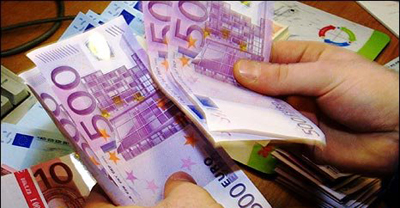 NEW YORK: The euro fell on Monday after a German official suggested a second Greek bailout was not yet certain, but traders said the prospect of higher euro zone interest rates would probably limit the currency's losses.
Policymakers have inched toward a new bailout package for Greece that German media said could exceed 100 billion euros, and that helped the euro hit a one-moth high of $1.4658.
It dipped below $1.46 after a spokesman for the German finance ministry said a second aid program was not yet certain. It was last down 0.1 percent at $1.4612.
Greece received a 110 billion euro aid package a year ago.
Traders, though, said the market assumes a deal will be reached to allow Greece more time to repay its debt and that markets also were already bracing for ECB President Jean-Claude Trichet to signal on Thursday plans to raise euro zone interest rates in July.
"The focus will turn toward interest rate differentials, and with the Federal Reserve unlikely to do anything this year, an ECB rate hike will pull money toward the euro and other currencies," said Boris Schlossberg, head of research at GFT Forex. "There's no reason whatsoever to own dollars now."
If Trichet uses the phrase "strong vigilance" when talking about inflation pressure, a hint that rates will rise in July, Schlossberg said the euro could retest its 2011 high around $1.4940.
For now, options barriers were stacked around $1.4700, traders said, with resistance also seen at $1.4710 -- the 76.4 percent retracement of the euro's decline in May.
The dollar also hit a one-month low at 79.97 yen before rebounding to 80.20 yen, down about 0.1 percent. Asian sovereigns were said to be dollar buyers below 80 yen.
Commodity currencies also benefited from weakness in the greenback. The Australian dollar was up 0.2 percent at $1.0747, near Friday's 3-1/2 week high of $1.0775. It remained some way off a 29-year peak of $1.1012 set on May 2.
BNP Paribas quantitative currency strategist James Hellawell said short-term momentum indicators pointed to more euro/dollar gains, but this was due to the dollar generating strong bearish momentum rather than a notable improvement in euro sentiment.
The dollar index dipped as low as 73.643 -- a trough not seen since May 5. A recent spate of soft US data has raised concern about the strength of the US economy. A report Friday showed a sharp slowdown in job creation, pushing the unemployment rate up to 9.1 percent.
With the Fed not likely to lift interest rats for some time, investors should continue to short the dollar, said Faros Trading head of research Dan Dorrow, "especially against capacity-constrained, rising-interest-rate currencies like the Indian rupee and Brazilian real."
Copyright Reuters, 2011






















Comments
Comments are closed for this article.