


Investors run for safe-havens on US data

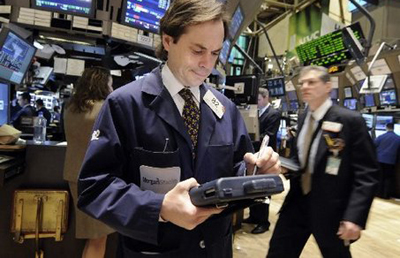 NEW YORK: Investors fled from the US stock market and the dollar on Wednesday after employment and manufacturing data signaled that US economic growth may be slowing more quickly than expected.
Yields on benchmark 10-year US Treasury debt, the favorite asset of investors looking for a safe place to store cash when times get tough, fell below 3.0 percent for the first time since December.
Gold, another safe haven, rose nearly 1.0 percent, while crude oil prices fell by up to 1.0 percent.
"The sugar high that has buoyed the US economy over the past 6 months is wearing out, and there is little in economic growth or foundation to show for it. The US dollar has no choice but to weaken given exports are the only bright spot in the United States," said Douglas Borthwick, a managing director with Faros Trading in Stamford, Connecticut.
Growth in the US manufacturing sector slowed sharply in May with the Institute for Supply Management's (ISM) index of national factory activity falling to 53.5 in May, its lowest level since September 2009.
That followed surprising private employment data from payrolls processor ADP that showed poorer job growth in May than expected, leading many Wall Street banks to slash forecasts for Friday's May employment data.
ADP' survey showed private employers in the United States added a scant 38,000 jobs in May, nearly four times below that expected by the market.
The job additions were the lowest published by the ADP since September 2010. Total non-farm payroll numbers for May are not due from the US Labor Department until Friday, but analysts do expect the official data to be much better.
"It fits very neatly in with the puzzle we are putting together that speaks to another soft patch and really, a genuinely failed stimulus approach to growing the economy," said Peter Kenny, managing director at Knight Capital in Jersey City, New Jersey.
"And it's not just about jobs. It's about manufacturing, it's about real estate, it's about consumer confidence. This is one data point in a very broad picture, and it's not encouraging."
By 11:20 a.m. EDT, the Dow Jones industrial average was down 141.45 points, or 1.13 percent, at 12,428.34. The Standard & Poor's 500 Index was down 14.16 points, or 1.05 percent, at 1,331.04. The Nasdaq Composite Index was down 25.86 points, or 0.91 percent, at 2,809.44.
The benchmark 10-year US Treasury note was up 23/32, with the yield at 2.9734 percent.
The dollar fell 0.3 percent against a basket of currencies.
The euro stayed at a three-week high versus the dollar, although it fell to a record low against the Swiss franc, the preferred safe-haven among currencies.
Whilst the euro has rebounded lately on optimism that debt-plagued Greece may get a second bailout after all, some investors remain worried about the global picture, including the scheduled end this month of a $600 billion US stimulus, known in market jargon as Quantitative Easing 2, or QE2.
"With the QE2 package due to expire at the end of the month, there's no shortage of uncertainty as to what happens when the easy money disappears," said Cameron Peacock, market analyst at IG Markets. Surveys showing factory growth eased in Europe and Asia also sounded a note of caution for some investors.
Two surveys showed Chinese factories expanded in May for the 27th straight month, although at a slower pace, suggesting government efforts to curb credit are helping to cool the economy.
In Europe, fresh signs of decline among factories on the euro zone's debt-laden periphery tugged sharply on manufacturing growth across the region as a whole in May.
Copyright Reuters, 2011























Comments
Comments are closed for this article.