



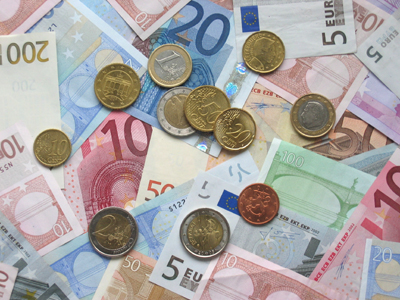
 NEW YORK: The euro bounced off a six-week low against the dollar on Thursday as an ECB policymaker said April's interest rate rise was ‘certainly not’ a one-off.
European Central Bank policymaker Luc Coene on Thursday told Reuters, inflation risks in the euro zone have increased and price pressures are building.
The ECB raised interest rates by 25 basis points to 1.25 percent in April to address the firming price pressures, ending two years of crisis-induced loose policy. Financial markets expect two more such rises this year.
The euro's gains reversed the earlier trend where the dollar index scaled a three-week high as a sell-off in commodities prompted an unwinding of dollar-funded bets on risky assets, the same reversal that pushed the euro to its multi-week low against the greenback.
‘Certainly the market is fixated on interest rate expecations and talk of a potential interest rate hike could give the euro a boost,’ said Gareth Sylvester, senior currency strategist at San Francisco-based Klarity FX.
The euro was last up 0.3 percent against the dollar at $1.4240, near the session peak of $1.4259, and well off the session low of $1.4121.
But analysts emphasized the single currency remained under pressure from euro zone periphery woes, as concerns increased that Greece's debt burden may be unsustainable. In earlier trade, the euro fell to 114.16, its lowest since March 24 against the yen.
Part of the single currency's turnaround came after US economic reports sent mixed signals, prompting some investors to remove bets on the dollar.
The US economy struggled to gain momentum early in the second quarter, with retail sales posting their smallest rise in nine months in April and wholesale prices increasing more than expected.
Other data on Thursday showed new claims for unemployment benefits fell 44,000 last week to 434,000, but they remained too high to signal a strong labor market recovery.
‘With the US data that came out this morning. people are getting positive and negative data and nothing to show the US economy is recovering or stalling,’ said Klarity FX's Sylvester. ‘The inconsistency in the economic data bought the euro/dollar off its lows.’
DOLLAR INDEX ON THE RISE
Speculation over whether Greece will receive more bailout funding kept risk appetite volatile as investors continued to price in a high probability that the country will eventually need to restructure its debt.
The dollar index rose as high as 75.645, its strongest in more than three weeks, taking it well above a three-year low touched only last week, before surrendering gains to trade at 75.182, down 0.2 percent.
The early broad recovery in the dollar also pushed it to a one-week high against the yen before it slipped back to trade at 80.77, down 0.4 percent on the day.
Among commodity-linked currencies, the Australian dollar was particularly weak, tumbling to a one-week low after surprisingly weak Australian jobs data reduced market expectations of a rate hike.
The Australian dollar and other commodity currencies did not react to China's move to increase reserve requirement ratios, although analysts warned this could add to the risk-off attitude in markets.






















Comments
Comments are closed for this article.