



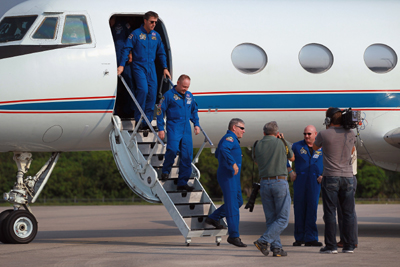
 CAPE CANAVERAL: Six astronauts arrived at Kennedy Space Center on Thursday ahead of the second to last US space shuttle flight, with Endeavour set to lift off on Monday after a technical delay.
The crew includes five Americans and one Italian astronaut, Roberto Vittori.
"It's great to be back," said shuttle commander Mark Kelly, whose lawmaker wife Gabrielle Giffords is recovering from a bullet wound to the head but plans to attend Monday's launch from Kennedy Space Center at 8:56 am (1256 GMT).
"We really appreciate all the hard work by the team that's worked over the last couple of weeks to get shuttle Endeavour ready."
The initial launch attempt on April 29 was scrubbed hours before liftoff when technicians discovered a power failure in a heating line that served to prevent fuel from freezing in orbit.
US space agency NASA said Monday engineers were confident that the problem would be fixed in time for launch on May 16.
The blastoff will mark the penultimate mission to the International Space Station (ISS) by a US shuttle before the storied program formally ends later this year with the mission of Atlantis, the final space shuttle to retire.
Endeavour's delay has pushed back Atlantis's planned liftoff from June 28 to mid-July, but no final date has been set.
NASA did say on Thursday that Atlantis would make its final journey from the processing hangar to the Vehicle Assembly Building (VAB) the day after Endeavour takes off on its 16-day mission.
"The first motion of Atlantis for rollover is scheduled for 8 am EDT (1200 GMT)" on May 17, NASA said in a statement.
"Inside the Vehicle Assembly Building, Atlantis will be attached to its external fuel tank and twin solid rocket boosters, which already are on a mobile launcher platform."
After the final shuttle missions, the three spacecraft in the flying fleet and the prototype Enterprise will be sent to different museums across the country.
Discovery was the first shuttle to retire after its last journey to the ISS ended in March.
Once the shuttle program formally ends, the world's astronauts will rely on Russia's space capsules for transit to and from the ISS until a new American spacecraft can be built by private enterprise.
Several US companies, including SpaceX, Boeing and Sierra Nevada Corp., are competing to be the first to build a next-generation space capsule by 2015.






















Comments
Comments are closed for this article.