



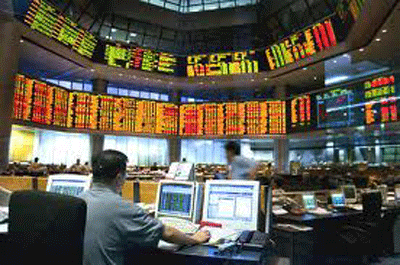
 LONDON: World stocks dropped further from recent three-year highs on Wednesday as falling commodity prices and concerns about signs of economic slowdown in China prompted investors to scale back risky positions.
Portuguese bond yields fell after the country agreed a three-year 78-billion-euro ($116 billion) bailout with the European Union and IMF on Tuesday, becoming the third euro zone country in a year, after Ireland and Greece, to seek financial aid. This week's 14 percent plunge in silver prices and a lower-than-forecast manufacturing growth reading in China have made investors nervous about holding big bets ahead of the European Central Bank meeting on Thursday and the April US jobs report due on Friday.
Before this week's decline, world stocks had risen more than eight percent this year as investors grew confident strong corporate earnings, robust growth in emerging markets and still ample liquidity would keep global growth at a reasonable level.
‘The market had a reasonably good run over the last couple of weeks and investors are just taking profits,’ said Bernard McAlinden, investment strategist at NCB Stockbrokers in Dublin.
‘Looking into the back end of this year, equities are still in a cyclical bull market and there is no ending signal yet. The market will also get support from earnings.’
The MSCI world equity index was down 0.3 percent, after hitting its highest level in almost three years last week.
The Thomson Reuters global stock index was also down around a third of a percent.
The FTSEurofirst 300 index fell 0.7 percent, led by weak mining and oil shares. US stock futures fell around 0.2 percent, pointing to a weaker open on Wall Street.
Emerging stocks lost 0.8 percent. Asian stocks outside Japan dropped 1.3 percent.
US crude oil was down 0.3 percent to $110.70 a barrel, weighed by concerns that China may tighten monetary policy further to curb inflation. Crude is still near a 31-month peak, keeping alive inflation worries.
German bond futures fell 40 ticks. The Portuguese/German 10-year government bond yield spread tightened to 677 basis points versus 695 bps at Tuesday's settlement close.
The dollar fell 0.1 percent against a basket of major currencies, edging towards a three-year low hit earlier this week. The euro was up 0.2 percent at $1.4853.
The ECB is expected to keep interest rates on hold having raised them in April, but the bank is expected to signal its readiness to tighten again and it may use its 'strong vigilance' code words to signal a rise as soon as June.
‘We expect the ECB to send a fairly straightforward signal on Thursday. Either the Governing Council states its 'strong vigilance' and the next rate hike would come in June or it 'monitors very closely' all developments, and a July rate hike is more likely,’ Credit Agricole said in a note to clients.
‘On balance, we still favour July, mostly because delivering a second rate hike two months after the first one on 7 April would signal a rapid tightening in the near term, thus running the risk of pushing the currency even higher.’






















Comments
Comments are closed for this article.