



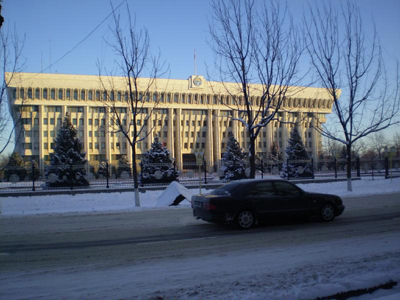
 ALMATY: A fragile coalition government in Kyrgyzstan is striving to subdue political and ethnic rivalries and entrench the first parliamentary democracy in Central Asia more than a year after a violent revolt toppled the president.
Angry crowds in the impoverished former Soviet state, which hosts both Russian and U.S. military air bases, ousted President Kurmanbek Bakiyev on April 7, 2010.
Two months later, ethnic bloodshed in the south of country killed more than 400 people.
Kyrgyzstan held elections on Oct. 10 that resulted in five parties winning seats in a new parliament. A majority coalition was formed at the second attempt in December, when parliament approved a new prime minister and cabinet.
Below is an overview of political risks in Kyrgyzstan:
POLITICAL REFORM
Kyrgyzstan is unique among the former Soviet republics of Central Asia in rejecting presidential rule and attempting to form a parliamentary democracy.
This followed 20 years of failed authoritarian leadership that included two revolutions.
Under a new constitution, the president will be limited to a single six-year term with greatly reduced powers. Parliament will be the key decision-making body.
Ata Zhurt, the Social Democratic Party of Kyrgyzstan and HRespublika formed a governing coalition, having come first, second and fourth respectively in the October election.
Betraying the fragility of the coalition, First Deputy Prime Minister and Respublika leader Omurbek Babanov resigned temporarily on April 13 to pre-empt a challenge from rivals that had threatened to split the coalition.
Roza Otunbayeva, a former ambassador to London and Washington, will remain acting president until Dec. 31, 2011. Presidential elections are expected in the autumn. What to watch:
Two of the five parties elected to parliament, Ata Zhurt and the pro-Russian Ar-Namys party, have said they oppose the parliamentary model. Political infighting has stifled attempts to push through reforms.
How will parties outside the coalition conduct themselves in parliament? Voters chose parties with widely divergent policies and the risk of violence is high should supporters feel that their parties are being sidelined.






















Comments
Comments are closed for this article.