



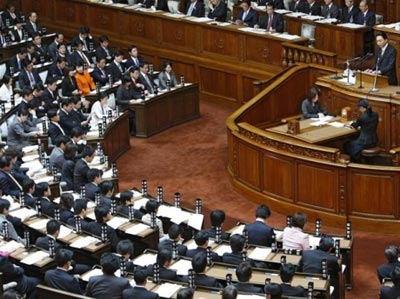
 TOKYO: Japan's lower house of parliament passed an emergency budget on Saturday worth 4 trillion yen ($48.5 billion) for rebuilding after the devastating March 11 earthquake and tsunami, a downpayment on the country's biggest public works effort in six decades.
The budget is expected to pass into law on Monday when the upper house of parliament votes on it. Lawmakers in the opposition parties that control the upper house have said they will back the first round of spending to finance such work as clearing rubble in the disaster-stricken northeast and building temporary housing for those who have lost their homes.
The emergency budget, which is likely be followed by more reconstruction spending packages, is still dwarfed by the overall cost of damage caused by the March 11 earthquake and tsunami, estimated at $300 billion.
Reaching agreement on subsequent packages is likely to be much tougher as they are expected to involve a mix of taxes as well as borrowing in the bond market, which could strain Japan's already debt-laden economy.
Prime Minister Naoto Kan, who has come under fire for his handling of the crisis, has said Japan may have to issue fresh government bonds to fund any more supplementary budgets.
If he is unable to steer those budgets through parliament, he may be forced to step down, some analysts say.
The magnitude 9.0 earthquake and 15-metre (50-ft) tsunami that followed threw Japan into its deepest crisis since World War Two, killing up to 28,000 people and destroying tens of thousands of homes.
It also smashed a nuclear power plant which began leaking radiation, a situation the plant's operator says could take all year to bring under control.
In the latest blow to Kan, one of his advisers on the nuclear crisis resigned in tears on Friday in protest at what he called the government's haphazard handling of the situation.
"The prime minister's office and administrative organisations have made impromptu policy decisions, like playing a whack-a-mole game, ignoring proper procedures," adviser Toshiso Kosako, a professor of antiradiation safety at the University of Tokyo's graduate school, told a news conference.

















Comments
Comments are closed for this article.