



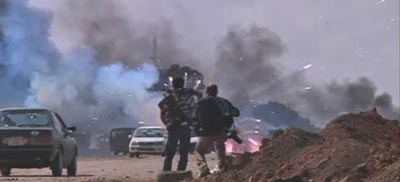
 BENGHAZI: Libyan rebels fire rockets and heavy machine guns against Muammar Qaddafi's troops in the east, a group of young volunteers are adding newsprint, television cameras and microphones to the arsenal.
Writers, cartoonists and musicians have been taking their work to the public after a popular uprising shook off decades of autocratic rule and state media dominance in the east, which the insurgents largely control.
Vibrant graffiti covers the walls in the rebel stronghold of Benghazi, rap songs attacking Qaddafi blare from speakers, and there is a crop of new media outlets.
Two radio stations, a television station and about a dozen newspapers and magazines have so far been licensed by the Benghazi-based rebel national council, Mohammed Fannoush, communication director for the council's media committee, said.
"It is a very easy to get licence," he said, sitting in a spacious office in the former government building where much of the new media is based.
"They write their names and the type of newsletter or newspaper, and I okay it."
As the country is now at war, much of the newly released creative energy has been used to refute statements by the official media still under Qaddafi's control and broadcast the aims of the uprising against his 41-year rule.
"Media is another one of our weapons now, after military equipment," said Mohamed bin Katou an 18-year-old writer for the Omar al-Mukhtar magazine, named after the legendary Libyan insurgent who battled the Italian occupation.
"You need to confront what they're saying on the Libyan channels like that we're al-Qaeda."
Libyan state television often refers to the rebels as armed gangs or militant and its programming is overwhelmingly dominated by footage of pro-Qaddafi rallies.
TELEVISING THE REVOLUTION
The Berenice Post, a weekly journal of articles and poems in Arabic and English, is one of the more lively examples of the newly found freedom of the press in eastern Libya.
Its latest issue the first with a glossy cover shows a pair of hands pressed together, as in prayer, with the word "Libya" written across the palms.
Volunteers working there said they saw dislodging Gaddafi's rule as a chance to give local media a modern touch.
"The old newspapers and magazines were a bit boring. No colours and the quality of the paper were very poor," writer Farah Gtat, 19, said.
"As young people, we wanted something that looks more attractive."
With schools shut, Gtat and others said they had been volunteering at the weekly in the hope it might help enliven the media scene and help counter stereotypes about Libya.
"We're not all journalists.
I'm still a student in high school. I haven't found out what I want to do in the future, but I'm doing this because I have to do something," writer Dilara Colakoglu, 17, said.
Rebels are also planning to launch a television channel, Libya Hurra, or "Free Libya", which they want to use to spread word of the revolt and its goals to countrymen in the west, which Qaddafi's forces control.
The station grew out of a live-stream video feed set up in the Benghazi courthouse that was the early centre of the revolt which began in earnest on Feb. 17.
Several volunteers used the equipment to send images of the demonstrations, and the ensuing government crackdown, to foreign media.
Rebels estimate over 300 people died in the early days of the protests in Benghazi alone.
One of those killed was Mohamed Nabbous, who set up the original video feed.
Friends say he was shot by a government sniper just days after launching Libya Hurra.
His image is now displayed prominently in the station's offices.
INDEPENDENCE
Volunteers are working to turn Libya Hurra into a proper news outlet.
Rolls of carpeting, crates of halogen lighting and the scent of fresh paint fill the gallery where they plan to set up studio.
Young broad-casters practice their on-air voices with teachers who help them brush up on the classical Arabic used by most Arab media outlets.
The station is already a source of pride for journalists such as Selma Bashir, 21, who returned from Egypt where she was studying journalism when the revolt AFP.
"The media in Libya was always talking about Qaddafi and his family, how great Qaddafi is, what an amazing human being he is," she said.
"Now, we can do something better, we can tell the truth about Qaddafi, about our country, about the good things and the bad things."
It will take a long time for Libya to develop a fully independent, critical press.
But the rebels are so far keeping their hands off the new publications with the sole exception of anything pro-Qaddafi, Fannoush said.
"After the liberation, if Qaddafi's people were to come and say, well, we want to publish a newspaper, I think they would be allowed to," he said.
"Since, we are at war we have to control this."

















Comments
Comments are closed for this article.