



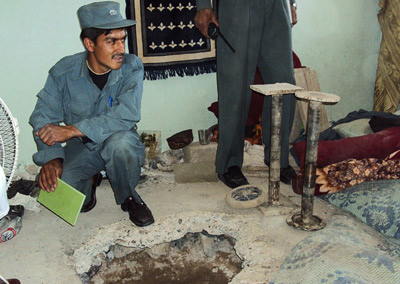
 KABUL: The daring prison escape of nearly 500 Taliban through a tunnel that took months to dig could never have happened without Afghan officials turning a blind eye or actively collaborating, experts said.
Some went further, suggesting they may even have condoned the plot as a way of building bridges with the Taliban and furthering peace efforts by President Hamid Karzai's government as NATO troops start withdrawing.
Either way, analysts agreed the operation at Kandahar prison was a major win for the Taliban at the start of the Afghan fighting season, which Western officials see as key to assessing how far a US-led troop surge has succeeded.
"This is a tremendous achievement for the Taliban because the Taliban were under heavy pressure in the greater Kandahar area... and now they have been able to free some high-profile commanders," political analyst Haroun Mir said.
"It is a morale boost for them."
The breakout took place over several hours overnight Sunday.
The Taliban claimed that only a few of the 488 escapees knew about the plot in advance, and woke their comrades in the night to lead them to freedom through a one-kilometre-long tunnel.
Mir said the incident highlighted how far the Taliban have managed to infiltrate the Afghan security forces, after recent attacks by militiamen who may have been serving as police or soldiers.
These included an attack on the defence ministry in Kabul last week committed by a would-be suicide bomber in army uniform and the assassination of Kandahar's police chief this month.
"These attacks indicate that the Taliban and other terrorist networks have a high degree of infiltration inside the Afghan security forces," he said.
"This tunnel is not an overnight work, it takes time, and definitely they have some collaborators inside the jail."
Another Afghan analyst, former diplomat Ahmad Sayidi, said it would be virtually impossible to dig such a long tunnel, which the Taliban said even passed under official checkpoints, without anyone noticing.
"When you dig a tunnel that long, you get over a hundred truckloads of soil and transporting that... is not possible without the prison authorities being involved," he said.
The director general of Afghan prisons, Amir Mohammad Jamshid, acknowledged that the Taliban escapees could have received assistance from guards working inside the prison.
"It cannot be ruled out," he said, but went on to claim: "Since this tunnel has not been dug from inside the prison it is not necessarily true that they (insiders) were involved."
The incident has drawn condemnation from Karzai's government. His spokesman Waheed Omer called the mass escape a "disaster" and acknowledged it highlighted "vulnerability" and "loopholes" in security.
But some analysts see hidden machinations in the escape.
Karzai's government is currently pursuing peace talks with Taliban elements as international combat troops prepare to start limited withdrawals from July ahead of a full pull-out by 2014.
Ahmad Massoud, a Kabul University lecturer and political commentator, said that since one of the Taliban's main conditions for talks is the release of its prisoners -- politically highly sensitive -- officials may have turned a blind eye to the escapes as part of the process.
"The escape is a political cover, this is a political move," he said. "This could not have happened without the knowledge or even facilitation of the Afghan government."
Afghanistan's deputy justice minister Mohammad Qasim Hashimzai was not available to comment despite repeated efforts to contact him Monday.
Mir, however, said he thought the break-out was due more to chaos than conspiracy.
"I certainly believe that the Afghan government, unfortunately, is almost paralysed," he said. "This is because of the weakness of the Afghan government, the weakness of the Afghan police force."


















Comments
Comments are closed for this article.