



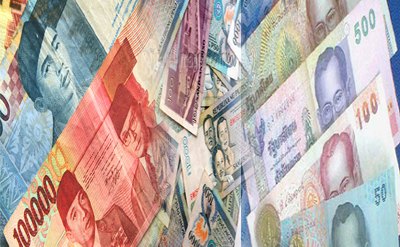
 SINGAPORE: The South Korean won and the Indian rupee led Asian currencies lower on Tuesday as investors took profits amid a drop in the stock market, but losses in the region were limited by exporters and a view that their bullish trend remains intact.
Emerging Asian currencies also slid against the yen as market players cut back carry trades, but they may use it as an opportunity to buy back some local currencies such as the won versus the Japanese unit, analysts and dealers said.
Investors also turned risk-averse after fears mounted that Greece will have to restructure its debt, possibly as early as this summer, and Standard & Poor's threatened to cut the United States' AAA credit ratings.
This prompted currency players to book profits from Asian currencies, which have enjoyed healthy gains on inflows to the regional stocks and bonds, as well as on expectations for further tightening by policymakers to fight inflation.
However, they still held dollar-short positions against the regional currencies to cover more, which will increase the pressure on them before the Good Friday holiday this week, dealers said.
"Faltering growth in the developed economies is not going to be something to help Asian countries, and could pose a threat to what is now a robust growth scenario. This dent in confidence is hurting Asian currencies and risk assets for the moment," said Christopher Gothard, Head of FX for Brown Brothers Harriman in Hong Kong.
Some Asian currencies have showed strong growth and investors may see a continued fall on more profit taking, although long-term growth story in Asian remains compelling, he added.
The Taiwan dollar has risen 4.2 percent against the greenback so far this year and the won also has gained about 4 percent. The Singapore dollar hit a record high on Friday.
However, their rising trend remain intact and currency players are likely to buy them on dips, analysts and dealers said.
"The market's reaction to buy USD/AXJ on the back of S&P's downgrade of US sovereign outlook is a knee jerk reaction and should be temporary," said a head of emerging Asian currency trading at a European bank in Singapore.
"In the medium term, a downgraded US sovereign outlook bodes well for EM debt as even a 5 percent rechanneling of bond flows from UST to EM governments. Bonds will see huge inflows into currencies like the KRW, BRL, IDR, MYR."
WON
The won slid as investors added dollar positions to take profits from the won's recent gains but recovered some of its earlier losses from exporters' demand for settlements.
Exporters bought the South Korean currency as it found strong support around 1,102, which the foreign exchange authorities had defended.
The won lost 0.8 percent to 13.2654 versus the yen , but the fall may provide investors to build up yen-short positions, dealers and analysts said.
The yen is approaching a solid band of resistance against the won in the 13.3000-13.4000 zone. This area, which had provided a solid base for this currency pairing since July, was finally broken last month.
This led to a relatively rapid decline in the yen/won to around 12.65.
Technically, the yen is in the process of retracing the rapid losses seen in March due in part to Group of Seven's efforts to weaken the yen in the aftermath of the Japanese earthquake.
This retracement should ideally be rejected by the former major support turned resistance in the 13.3000-13.4000 area.
Traders may consider selling the cross in the resistance zone with protective stops placed at 13.5000 for a retest of the low around 12.6500.
RINGGIT
The ringgit fell on dollar-short covering but interbank speculators sought chances to buy it whenever it weakened past 3.0300 per dollar, as it has supports around 3.0300 and 3.0400.
Earlier, the Malaysian currency weakened to 3.0350, the weakest since Mar 24.
The ringgit faces support at 3.0351, a 55-day moving average, and at 3.0400, a 50 percent retracement line of its March-April rising.
"I had expected USD/MYR to test 3.0350-3.0400, but people are selling it around 3.0300-3.0310 today," said a Kuala Lumpur-based dealer.
The ringgit also found support from selling Singapore dollar against the Malaysian currency. The ringgit edged down to 2.4244, but market is targeting its next support at 2.4150.
RUPEE
The Indian rupee fell to a 2-1/2 week low, tracing losses in the euro and Asian currencies as risk aversion dominated market sentiment against the backdrop of sovereign debt problems in Europe and the United States.
Rohan Naik, head of foreign exchange trading at Standard Chartered Bank in Mumbai, said he does not see the rupee weakening beyond 44.70/75, which is a technical support level.
SINGAPORE DOLLAR
The Singapore dollar slid on sales from leveraged accounts and interbank speculators.
The city-state's currency found some demand when it weakened past 1.2500, but market players stayed wary of further risk aversion and US dollar-short coverings by interbank speculators.
PESO
The peso slid on dollar-short coverings, but leveraged accounts showed interests in buying the Philippine currency on dips at its session low of 43.47 per dollar.
Markets are also wary of dollar selling from the central bank at the 43.50 support.




















Comments
Comments are closed for this article.