


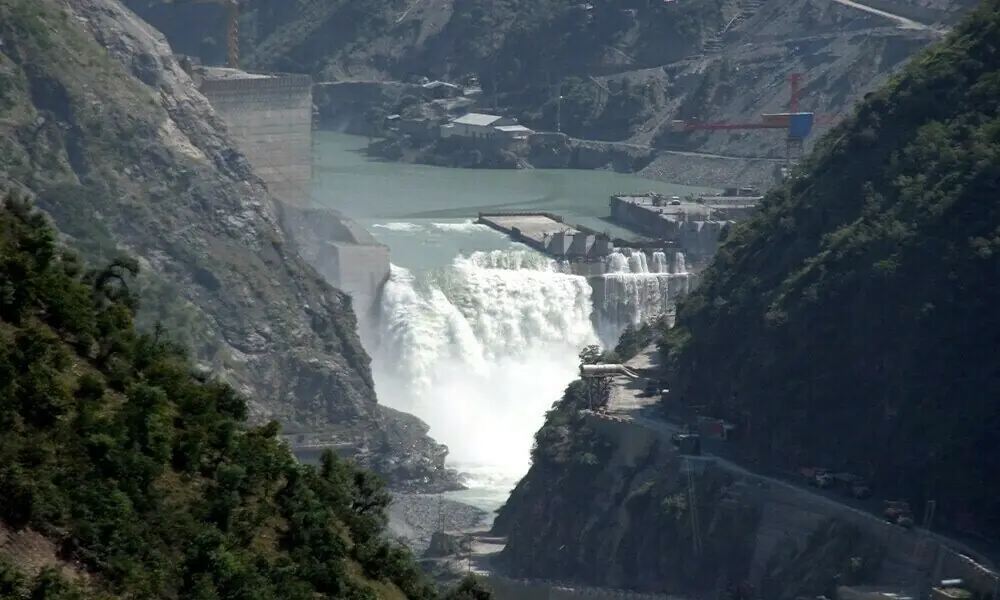
EDITORIAL: Reports that India abruptly released a large volume of water at Head Marala and then sharply reduced flows in River Chenab, to between 870 and 1,000 cusecs for many consecutive days, have triggered serious concern in Pakistan, particularly as the disruption coincided with the critical wheat sowing season. For farmers in Punjab, the inability to complete the first watering of their crops poses a direct threat to livelihoods and food security.
Not surprisingly, the Foreign Office in Islamabad has described these sudden variations as a matter of “extreme concern and seriousness.” In an agrarian economy where millions rely on predictable irrigation cycles, abrupt changes in river flows can quickly translate into reduced yields, higher food prices, and greater vulnerability for the rural poor.
The Foreign Office spokesman’s assertion that the releases were made unilaterally and without prior notification or data sharing strikes at the very core of the Indus Waters Treaty (IWT), which is founded on cooperation, transparency, and institutionalised dispute-resolution mechanisms.
Long regarded as one of the world’s most durable water-sharing agreements, the IWT has endured wars and prolonged political hostility between the two neighbours. Its resilience lies in its status as a binding international treaty that curbs unilateral actions and channels disputes through commissioners, neutral experts, and arbitration. Pakistan’s decision to approach India through the Indus Water Commissioner is therefore fully consistent with both the letter and the spirit of the treaty. Any perceived manipulation of river flows outside agreed procedures risks undermining a framework that has, for decades, prevented water disputes from spiraling into open conflicts. The present controversy, however, is linked to the ruling BJP’s inclination to stoke anti-Pakistan sentiment for domestic political gain.
Since last April’s Pahalgam terrorism incident, the Modi government’s decision to place the IWT in abeyance has injected dangerous uncertainty into transboundary water governance.
While experts agree that a complete blockade of the three western rivers allocated to Pakistan is technically implausible in the near term, selective emptying and refilling of upstream reservoirs can, nonetheless, inflict significant harm downstream. Notably, in its ruling of August 8, 2025, the Court of Arbitration characterised such practices as “water weaponisation” and reaffirmed that India cannot unilaterally suspend the treaty.
Pakistan, for its part, has repeatedly warned that the use of water as a weapon would be viewed as an “act of war,” a formulation that sharply raises the stakes. In a nuclearised region already burdened by deep mistrust, even limited disruptions heighten the risk of miscalculation and escalation.
The current situation underlines the urgent need to depoliticise river management and recommit to cooperative mechanisms. Predictable flows, advance notifications, and transparent data sharing are not favours but binding obligations under international law. Upholding them is essential. The alternative — normalising abrupt disruptions — would turn water from a shared resource into a persistent flashpoint, to the detriment of peace and stability in the region and beyond.
Copyright Business Recorder, 2025

























Comments
Comments are closed for this article.