


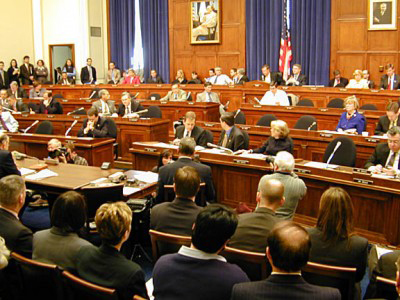
 The hearing in a US congressional sub-committee on the situation in Balochistan last week, has received yet another stiff rebuke, this time through a unanimously adopted resolution of the National Assembly. Condemning the move as "blatant interference in Pakistan's internal affairs" the House warned that the move could jeopardise the "healing process" now said to be in the making as it tends to inflame public opinion. Earlier at various administrative levels, the government has lodged strong protests against the hearing episode which had all the aspects of a professionally cooked up anti-Pakistan campaign at the international level. The United States government has disowned the hearing, as is often the case when the services of non-government entities and think tanks are requisitioned to produce environments for a diplomatic move to follow sometime. That some of the Western capitals have hosted and nurtured anti-Pakistan Baloch leaders by giving them a free hand to malign military and security forces, is well-known and the people of Pakistan are used to their occasional outbursts. But this hearing on the Capitol Hill and its timing has a disturbing dimension as it comes coincidental to critical developments in the region, particularly the Iran-US stand-off on the nuclear issue. Then there are the concerns that Washington tends to share with New Delhi over the growing Pak-China strategic relationship that are likely to accentuate now that the Afghan war has entered its endgame scenario. No doubt the hearing in the US Congress is critical, as it comes in the wake of critical developments in this region. But is our response, public and official, sufficiently well-calibrated? Frankly, it is not. The fact, as amply reflected from the prevailing atmosphere in the House at the time the Leader of Opposition tabled the said resolution, strongly suggests that the effort was much more for the gallery than a sincere effort. Given that the government is anxious to win the opposition's support on the 20th constitutional amendment passage, the treasury was more than willing to endorse the resolution. One would even suspect that consensus on the floor of the National Assembly was no less arguable the product of shared apprehension that political forces outside the parliament, including the Defence of Pakistan Council, are likely to highjack the issue. Also, this is not the first parliamentary resolution condemning US interference and its fate is not expected to be any different from the earlier. It is strange if not comical that our parliament which never tires of claiming supremacy over all other national institutions has not been able to implement any of the resolutions it has angrily adopted to condemn the United States. We may like to downplay the ongoing insurgency in Balochistan but that may be an exercise in self-deception. Balochistan today is a picture of near civil war with death and mayhem stalking the province. Not a day passes when it is not rocked by rockets fired by the insurgents or there are incidents of targeted killings on ethnic and sectarian basis - most of it blamed on the security forces giving the anti-Pakistan forces adequate cause to seek international intervention. And mind you that is no more a big problem given that in recent years such demands have been met. And in that even the United Nations becomes a party, as it did in Afghanistan, Libya and narrowly missed its objective in Syria for what it called a 'regime change'. But all is not lost yet; this challenge of foreign interference can be effectively met by putting our own house in order. Foremost, the people of Balochistan have to be convinced not by words alone but by actions that they are equal partners in the scheme of things called Pakistan. Then there has to be drastic modernisation of the political system mainly by liberating the people from anarchistic legacy left by the colonial power who created sardars and nawabs as their agents to control the masses. Also, the province of Balochistan must receive generous federal financial support in addition to its due share to build a strong infrastructure which helps deliver services that help people improve their quality life. Finally, honest, efficient and independent bureaucracy including law-enforcement set-up has to put in place. These are undoubtedly huge challenges but have to be met in time for the alternative is too dangerous as it poses an existential threat to us as an independent nation. Copyright Business Recorder, 2012























Comments
Comments are closed for this article.