



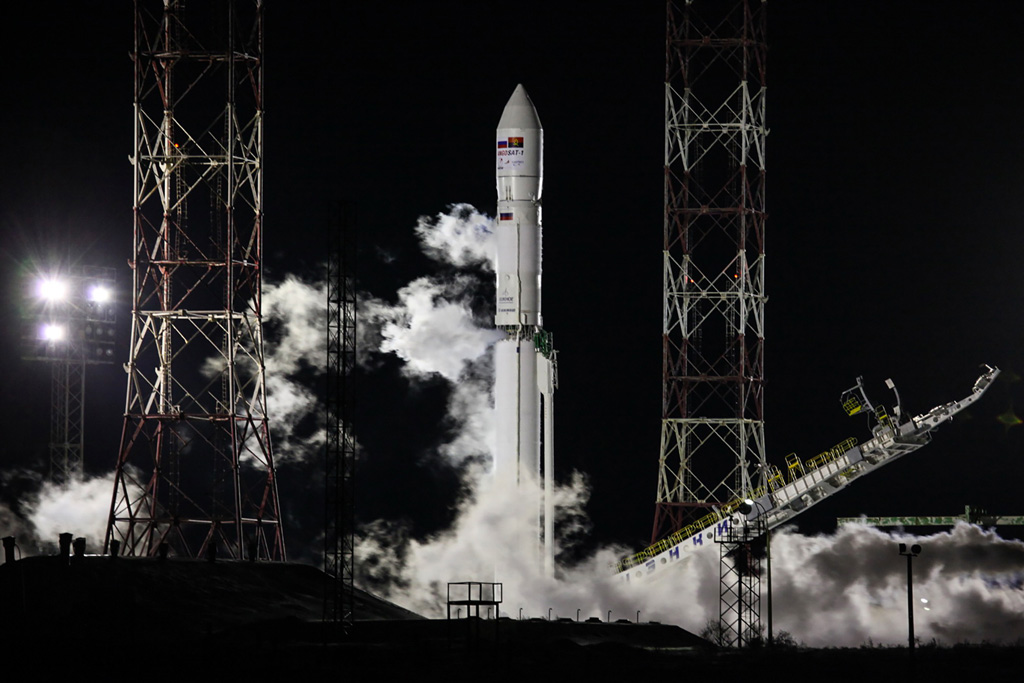
 MOSCOW: Russia has lost contact with Angola's first national telecoms satellite launched from the Baikonur space pad, its maker said Wednesday -- a fresh embarrassment for Moscow's once proud space industry.
The incident involving the Russian-made Angosat-1 followed a similar one in November when Russia lost contact with a weather satellite launched from a new cosmodrome in the country's far east.
Energia, Russia's top spacecraft maker which produced the satellite for Angola, said it had reached orbit and established communication according to plan but "after a while it had stopped sending telemetry" data.
"Energia specialists are analysing telemetry at their disposal," the company said in a statement, adding it was working to re-establish contact.
The reason for the loss of contact was not given.
Earlier Wednesday a source in the space industry told AFP that contact with the satellite had "temporarily" been lost. The source called it a "rather common situation."
Energia said similar incidents had happened before with satellites in other countries including the United States and Kazakhstan.
In 2006, NASA reestablished communication with a satellite nearly two years after losing contact with the spacecraft.
- 'Wait 24 hours' -
Sources at the Angolan space agency said that it would be premature to comment on the apparent communication breakdown.
"It's correct that after the launch there was a (communications) disconnect," Da Costa N'ganga, marketing director at Infrasat, a company in Angola overseeing the satellite project, told AFP.
"The nature of the technology means that we will need to wait 24 hours to know for sure what has happened," he added.
The satellite -- financed by a loan from Russia -- was meant to boost telecommunications in one of Africa's top oil producers.
Russia and Angola agreed to pursue the approximately $280 million project --- which includes the satellite, its launch, and on-ground infrastructure in a suburb of the capital Luanda -- in 2009.
The funding for the project was agreed in 2009, during a visit to Angola by Dmitry Medvedev, Russian president at the time.
The satellite was produced by Energia using a "number of innovative solutions," the Russian space agency said.
The satellite was designed for a 15-year mission to boost satellite communications, internet access and radio and TV services.
Around 50 Angolan aerospace engineers trained around the globe were meant to oversee the functioning of the satellite from a control centre built near Luanda.
The Zenit-2SB rocket carrying Angosat to orbit was supplied by Ukrainian maker Yuzhmash.
That made the launch a rare joint project between Russia and Ukraine, after Russia annexed Ukraine's Crimea peninsula in 2014.
- 'New client' -
"It is too early to bury the satellite," said space expert Vitaly Yegorov.
"But the incident with Angosat is bad because Angola is a new client," he added, noting that Russia was hoping for more such contracts with developing countries.
"They had waited for this launch for many years," he said, referring to Angola.
"This case may affect other developing countries interested in working with Russia."
Yegorov suggested that the satellite might have been damaged due to long storage on Earth.
In late November Russia lost contact with its Meteor-M weather satellite after its launch from the new Vostochny cosmodrome in the far east -- only the second such launch from the new spaceport.
Apart from the weather satellite, the rocket carried 18 payloads from institutions and companies in Canada, the United States, Japan, Germany, Sweden and Norway.
In October, Russia successfully launched from the northern cosmodrome of Plesetsk a European satellite dedicated to monitoring the Earth's atmosphere.
Sending the first man into space in 1961 and launching the first sputnik satellite four years earlier are among key accomplishments of the Soviet space programme and remain a major source of national pride in Russia.

















Comments
Comments are closed for this article.