



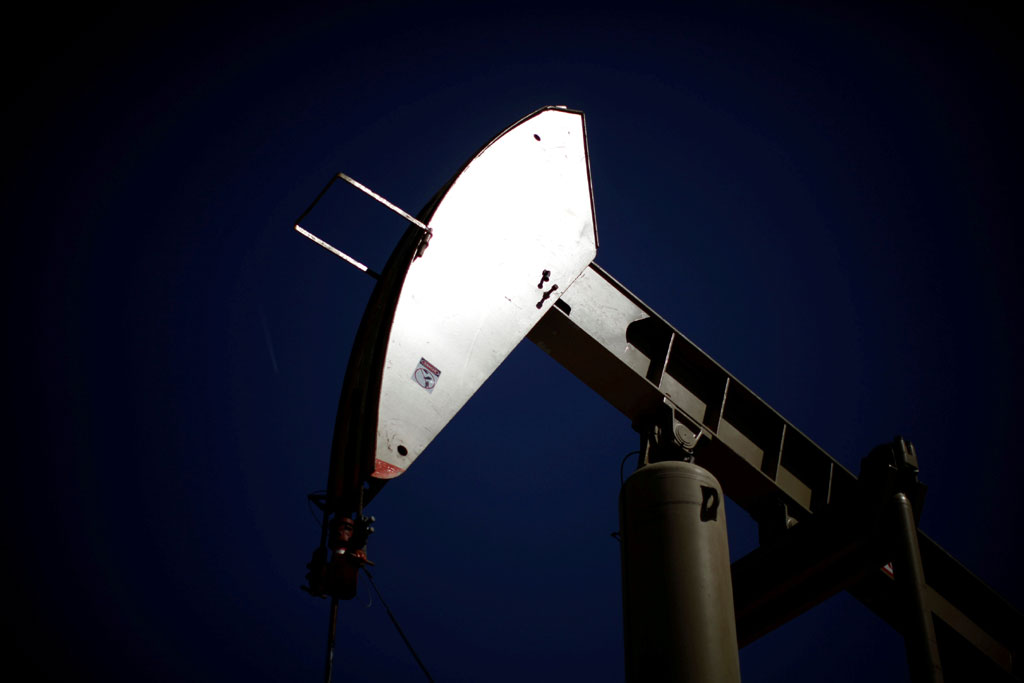
 LONDON: Crude oil slid lower on Monday on signs that the United States is continuing to add output, largely counteracting strong economic growth in China and OPEC efforts to cut production.
Benchmark Brent crude futures were down 50 cents at $55.39 at 1126 GMT. On Thursday, before major markets closed for a holiday break, they settled up 3 cents at $55.89 a barrel.
US West Texas Intermediate (WTI) crude futures were down 47 cents at $52.71 a barrel, after rising 7 cents to $53.18 on Thursday.
Both benchmarks had risen last week for a third consecutive week, with Brent adding 1.2 percent over the four days before the Good Friday holiday and WTI up 1.8 percent.
While trading was subdued, the focus was on indications that shale oil output in the United States was pushing higher.
"All the signs of an ever-growing bull market are starting to fade away, (with) Libya and geo-political tensions easing, but also because the Texans are back and they are pumping like there's no tomorrow," said Matt Stanley, a fuel broker at Freight Investor Services (FIS) in Dubai. "If I were OPEC, I'd be pretty worried."
Although the failure of a ballistic missile launch in North Korea brought some respite, markets were braced for further tensions in the region.
In Libya, fighting between rival factions has cut oil output, but state oil company NOC was able to reopen at least one field and was pushing to reopen another.
US drillers last week added rigs for a 13th straight week, bringing it to its highest in roughly two years. Investors are also pouring money into the industry, suggesting US output gains will continue.
Increasing US output is undermining attempts by the Organization of the Petroleum Exporting Countries and other major oil producers to curb output and sustain a price rally in a market that has been oversupplied since mid-2014.
While Iran fuelled hopes that OPEC and non-OPEC oil producers could extend their output cuts beyond the six-month agreement, Saudi energy minister Khalid al-Falih said it was too early to discuss an extension.
US crude oil production reached 9.24 million barrels per day (bpd), according to the latest Energy Information Administration data, making it the world's third-largest producer after Russia and Saudi Arabia.
The increasing production largely counteracted figures showing first quarter economic growth of 6.9 percent in China. Forecast-beating March investment, retail sales and exports all suggested China's economy, the world's second-largest oil consumer, may carry solid momentum into spring.
China's March refinery throughput also rose to 11.19 million bpd, just shy of December's record, as margins remained attractive.
























Comments
Comments are closed for this article.