



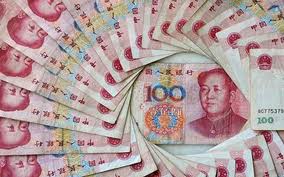
 SHANGHAI/HONG KONG: China's yuan held near the day's lows on Thursday as heavy dollar buying by state-run banks in the foreign exchange market this week forced traders to be wary of chasing more yuan gains.
The Chinese currency has risen by more than 2 percent so far this year and its steady rise has attracted capital flows from investors who have sought a shelter from other volatile currencies such as the Indonesian rupiah and the Indian rupee.
But heavy flows have complicated the task of monetary authorities who have to balance demands to make the exchange rate more market-determined by widening its trading band while preventing a strong currency from hurting its export sector.
That has prompted Beijing to adopt a dual approach by ratcheting the yuan's daily fixing steadily higher against the US dollar on one hand and intervening via its state-run banks in the cash foreign exchange market to narrow the gap between the two exchange rates on the other, traders say.
On Thursday, the yuan was trading at 6.0920 per dollar, nearly unchanged from Wednesday's close of 6.0928 despite the People's Bank of China fixing the currency at a new post 2005 revaluation high.
"The yuan was pushed back shortly after it hit an intraday high of 6.0905 this morning, continuing a trend since late October that it has always faltered ahead of the 6.09 resistance," said a trader at an Asian bank in Shanghai.
"Major Chinese state-owned banks have recently bought excessive dollar supply in the market, believed to help the central bank curb the pressure of yuan appreciation."
The central bank has controlled the pace of yuan rises since the currency's landmark revaluation in 2005, letting it mainly appreciate during major political events, such as Chinese leaders' visits to the United States or participation in global events, while maintaining stability at other times.
But in recent weeks, that iron-clad control has started to wear thin as the Chinese currency has donned the mantle of a safe-haven status within the region as US Treasury yields have tiptoed higher and other Asian currencies have weakened, signaling growing investor caution.
"The recent data momentum out of China has painted a resilient picture for activity momentum as we progress through Q4," said Jonathan Cavenagh, a strategist at Westpac Securities in Singapore.
"This, combined with rising food inflation pressures, is likely to leave the authorities fairly comfortable with continued broad-based strength in CNY."
That optimism has meant that Beijing has had to step up its intervention in the markets which has injected massive sums of money into the monetary base, flooding China's banking system with an abundance of liquidity from time to time and forcing it to step up draining excess in the money markets in recent weeks once again.


























Comments
Comments are closed for this article.