



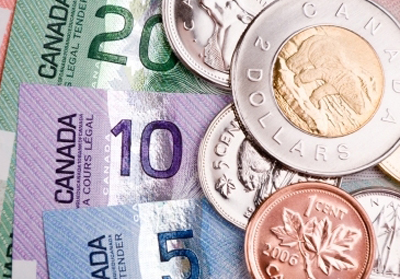
 TORONTO: Canada's currency steadied in a narrow range after touching a more than seven-week high against the US dollar on Tuesday as investors consolidated gains following a five-day advance.
The Canadian dollar underperformed against other major currencies against a broadly weaker greenback, including the euro after better-than-expected German investor sentiment data.
"As the euro has rallied, you've seen some weakness not only in the US dollar but in the Canadian dollar against the crosses, so that, if anything, has kept the Canadian dollar pretty static against the US here," said Matt Perrier, director of foreign exchange sales at BMO Capital Markets.
The other main focus for investors was a meeting of the Federal Reserve and "fiscal cliff" talks in the United States to avoid $600 billion of previously drawn-up spending cuts and tax hikes set to begin in the new year.
When the Fed concludes its meeting on Wednesday, the central bank is expected to extend its asset-purchase scheme and commit to buy $45 billion of US debt each month.
At 8:01 a.m. (1301 GMT), the Canadian dollar stood at C$0.9874 versus its US counterpart, or $1.0128, compared with Monday's session close at C$0.9870, or $1.0132. The currency was stuck in a narrow range between C$0.9862-C$0.9880 but still edged up to its strongest level since Oct. 19.
A close higher on Tuesday would mark the sixth straight daily advance for the currency after the Canadian government's approval of two big takeovers and a hawkish sounding central bank boosted confidence over the past week.
Market players will be looking at domestic trade data due at 8:30 a.m. for further direction.
Perrier pointed to US dollar support around C$0.9845, followed by C$0.9815-20.
He noted resistance in the C$0.9910-20 area. "You'd probably see some of the more recent entrants into the short dollar/Canada trade probably feel a little bit of pain on a move through there," Perrier added.
Canadian bond prices eased across the curve as global stock markets advanced, buoyed by the pick-up in German confidence and expectations the Federal Reserve will keep pumping money into the US economy.
Canada's two-year bond fell 3 Canadian cents to yield 1.070 percent, and the benchmark 10-year bond lost 9 Canadian cents to yield 1.710 percent.
**























Comments
Comments are closed for this article.