



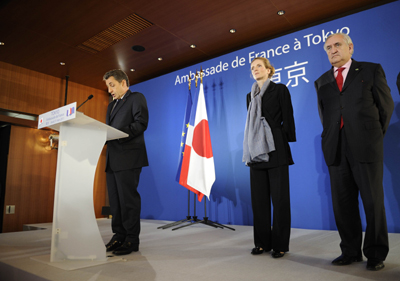
 NANJING: Finance ministers made modest progress on Thursday towards reform of a global monetary system that French President Nicolas Sarkozy said is so unstable that it could tip the world economy back into crisis.
Ministers and central bankers from the Group of 20 leading economies edged towards a consensus on the need to include China's yuan in the basket of currencies that makes up the Special Drawing Right, the International Monetary Fund's in-house money.
Adding China's currency to the SDR would be a recognition of China's ever-growing economic clout and would be a concrete step toward making the global monetary order more representative and, ministers hope, more solid.
"Without rules, the international monetary and financial system is incapable of forestalling crises, financial bubbles and the widening of imbalances," Sarkozy said in opening a day-long G20 seminar in this eastern Chinese city.
"Without rules and supervision, the world runs the risk of being condemned to increasingly serious and severe crises," he told an audience that included IMF head Dominique Strauss-Kahn, who is widely expected to run for president against Sarkozy next year.
France is the chairman this year of the G20, which brings together developed and emerging economies accounting for some 85 percent of global output.
Beijing, despite being asked to host the forum, has not shown great enthusiasm for Sarkozy's initiative.
"The reform process will be long-term and complex," Chinese Vice-Premier Wang Qishan said in his opening remarks.
LET'S GET STUDYING
China suspects that the West is looking for new levers to force Beijing to let the yuan, now tightly managed by the central bank, trade more freely and to dismantle its capital controls more quickly than it wants to.
These conflicting interests crystallised in Nanjing over the conditions for including the yuan, also known as the renminbi (RMB), in the SDR.
The SDR, now comprised of the dollar, euro, yen and sterling, is a synthetic quasi-currency that is mainly used as an accounting tool for the IMF's internal operations.
Its reach is otherwise limited -- Libya pegs its currency to the SDR and transit fees through the Suez Canal are calculated in SDRs -- but some experts believe the SDR could evolve over time into an important international reserve asset alongside the dollar.
French Finance Minister Christine Lagarde said there was no particular timetable for adding the yuan to the SDR, a step that would come with strings attached.
"We discussed the conditions that apply to belonging to the SDR basket and in particular we focused on the convertibility and flexibility of the currency and the relative independence of the central bank," she told a closing news conference.
Studies along those lines could start soon, she said.
As much as Beijing would like the kudos that being a component of the SDR would entail, Chinese officials bristled at the idea of strict conditions.
Yi Gang, a vice-governor of the central bank, disputed the notion -- voiced by European Central Bank Governor Jean-Claude Trichet among others -- that a currency must be freely-floating before it can be included in the SDR.
Yu Yongding, a former central bank policy adviser, took issue with the demand that an SDR component currency must be managed by an independent central bank -- a demand most forcefully articulated by US Treasury Secretary Timothy Geithner.
The People's Bank of China is far from autonomous: the most important decisions concerning the exchange rate and monetary policy are made by Communist Party leaders.
"It will take time for the RMB to be part of SDR," Yu told Reuters.
PROGRESS AHEAD?
Nevertheless, German Finance Minister Wolfgang Schaueble said he expected more headway on the issue in coming months.
"I believe we made a lot of progress in this direction today. I am confident that a lot will be achieved in this direction in the French presidency," he said.
In his prepared remarks for the seminar, Geithner questioned whether an international effort was really needed to cure the ills in the global monetary system. Inconsistency in exchange rate policies was the biggest flaw, he said.
Without naming China, he noted that some emerging countries ran tightly-managed currency regimes that fuelled inflation risks in their own economies, magnified appreciation pressures in others and also generated calls for protectionism.
"This asymmetry in exchange rate policies creates a lot of tension," Geithner said. "This is the most important problem to solve in the international monetary system today."
But he said the solution was not complicated.
"It does not require a new treaty, or a new institution. It can be achieved by national actions to follow through on the work we have already begun in the G20 to promote more balanced growth and address excessive imbalances," he said.




















Comments
Comments are closed for this article.